By Prince Abdulsalami Ladigbolu‑Oranmiyan, UNESCO REF President.
Democracy Day and a Sobering Reality
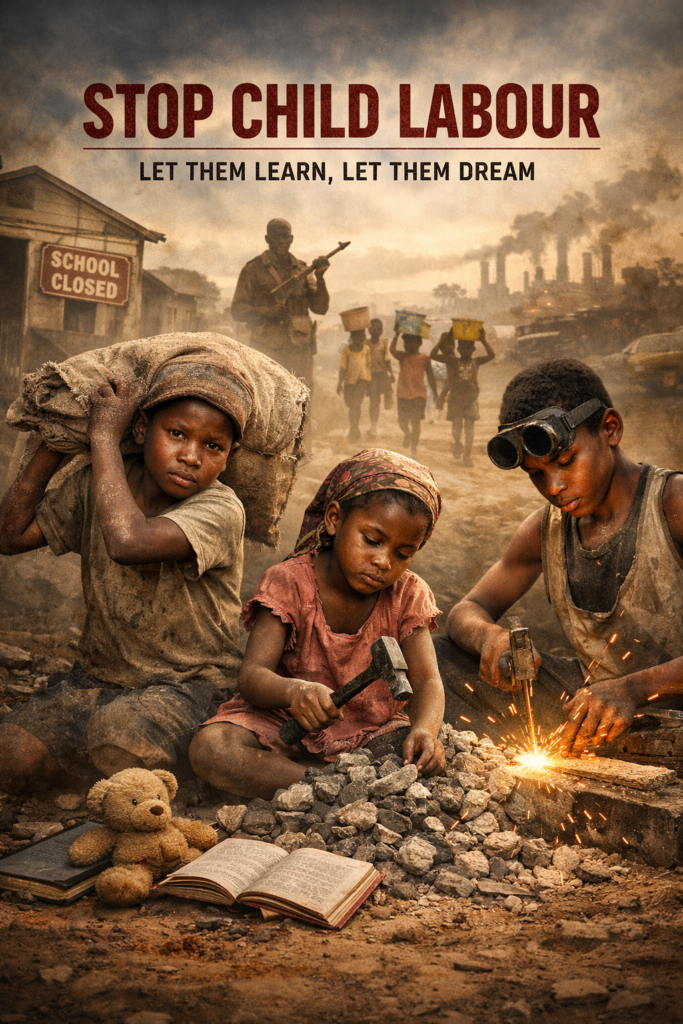
As Nigeria commemorates Democracy Day alongside the International Day Against Child Labour, the nation must confront a sobering truth: child labour is not merely an economic or social problem, it is a national security crisis. Children forced into labour, hawking on streets, mining in unsafe conditions, or performing hazardous tasks are denied education and hope. Extremist groups exploit this vulnerability, turning poverty into a recruitment pipeline. Every child lost to labour is a potential recruit diverted from classrooms into conflict, from innovation into insurgency.
Nigeria’s Greatest Resource at Risk
Nigeria’s greatest resource is not oil or minerals, it is its people. Yet child labour steadily erodes this foundation, reducing the nation’s intellectual capital and weakening its ability to compete in a knowledge‑driven world. Protecting children today is therefore not just a moral duty, it is a strategic imperative for Nigeria’s survival and growth.
Democracy is built on participation, inclusion, and opportunity. Child labour undermines these principles by silencing millions of voices before they can even be heard. A democracy that fails to protect its children is a democracy at risk.
Linking the Fight to Global Goals
This fight is inseparable from the United Nations Sustainable Development Goals (SDGs):
- SDG 4 Quality Education: Ensuring every child has access to inclusive, equitable, and quality learning.
- SDG 8 Decent Work and Economic Growth: Breaking cycles of poverty and exploitation through safe, dignified opportunities for families.
- SDG 16 Peace, Justice, and Strong Institutions: Protecting children from recruitment into violence and building democratic resilience.
- SDG 17 Partnerships for the Goals: Fostering collaboration between Nigeria, international partners, and civil society to dismantle child labour and terrorism pipelines.
A Call to Leadership and Partnership
At this critical juncture, UNESCO REF President Prince Abdulsalami Ladigbolu-Oranmiyan calls upon President Bola Ahmed Tinubu to inject an intersection of fresh ideas that synchronize the Ministry of Culture, the Ministry of Information, and the Ministry of Humanitarian Affairs. The solution to this menace is in the hands of these ministries. Nigeria must empower intellectuals, not busy driven professionals to design and implement strategies that combine cultural renewal, information management, and humanitarian outreach. This effort must also be enhanced by cooperation between the Global North and South, recognizing that child labour and terrorism are shared challenges requiring shared solutions. Nigeria’s call is not for charity, but for partnership; a partnership that secures democracy and safeguards humanity.
Nigeria cannot confront this challenge alone. UN agencies, donor bodies, and international partners must join hands with Nigeria in eradicating child labour and dismantling the recruitment pipelines of terror. Partnership must translate into investment in education, building schools, training teachers, and ensuring access to quality learning for every child. It must include social protection systems that provide safety nets for families vulnerable to child labour, counter-terrorism strategies that integrate child protection into national and regional security frameworks, and community resilience programs that empower local leaders and families to resist extremist recruitment.
The eradication of child labour is not a distant goal, it is an urgent necessity. Nigeria must strengthen its laws, enforce accountability, and prioritize education as a national security strategy. International partners must provide technical expertise, funding, and solidarity. Civil society must continue to raise awareness and hold leaders accountable. This is a fight that requires multi-sectoral collaboration: government, private sector, civil society, and international organizations working hand in hand. The stakes are too high for complacency.
On this Democracy Day, let us affirm that democracy is not measured solely by ballots, but by the futures we safeguard for our children. The fight against child labour is inseparable from the fight against terrorism. By protecting Nigeria’s children, we protect Nigeria’s democracy and by extension, the stability of Africa and the world. The time to act is now. The world must not look away. Nigeria’s children deserve more than survival, they deserve the chance to thrive, to innovate, and to lead. The measure of our collective humanity will be judged by how we respond to this crisis