UNESCO REF Media Centre · The Dispatch · Audio Edition · EISSN 3156-5557

The UNESCO REF Podcast

Le podcast de l'UNESCO REF, journalisme sonore de long format

Long-form audio journalism from the centre of Nigeria's development conversation. Considered dialogue with leaders of government, diplomacy, education and enterprise, recorded and edited by the UNESCO REF Media Centre in Abuja. Season One, comprising four editions, premieres in the second quarter of 2027.

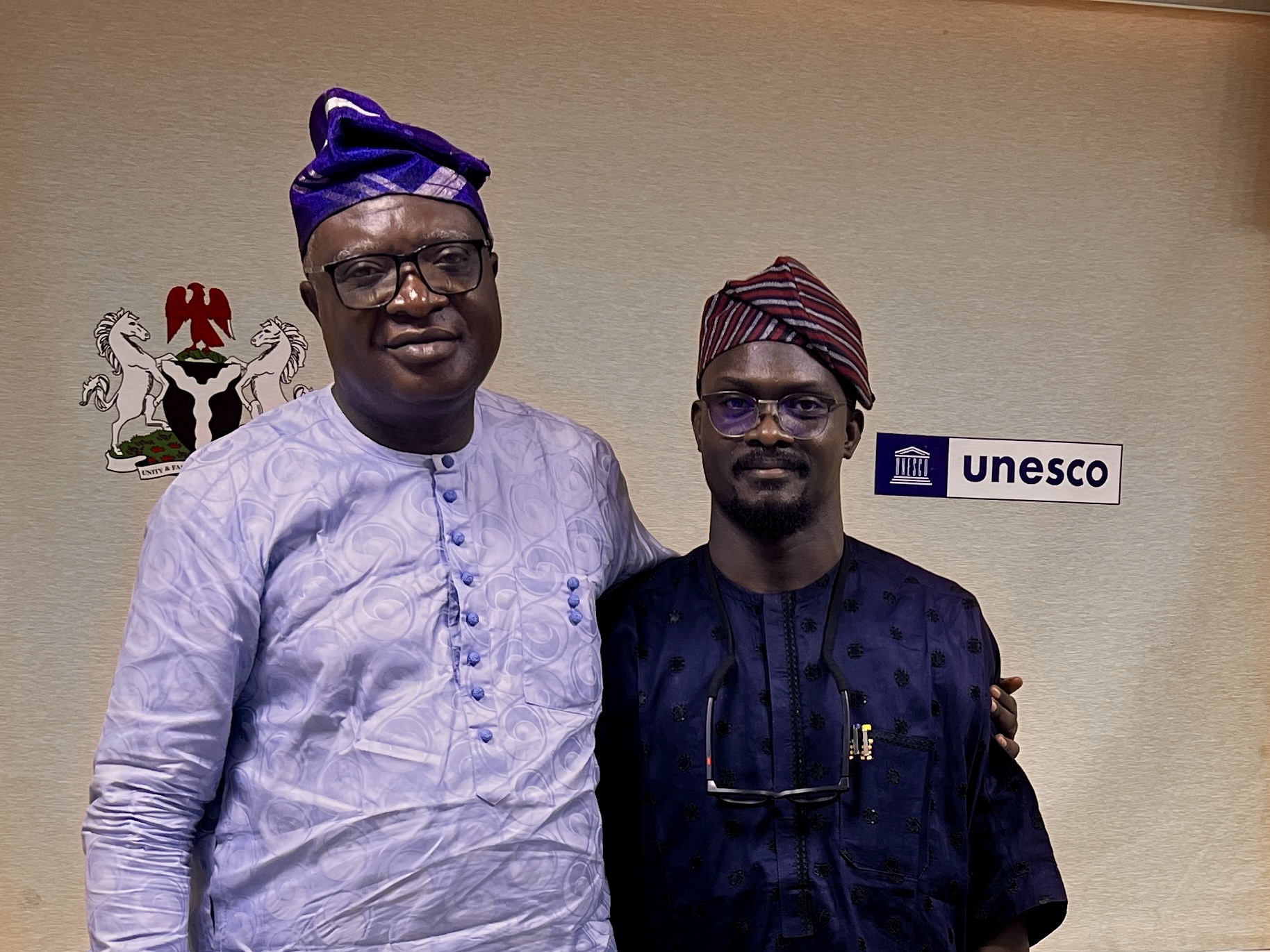
In conversationUNESCO REF in conversation. Photograph: UNESCO REF Media Centre.
Season One in productionFour editionsPremiere window: April to June 2027Second quarter of 2027
I

A Programme of Record in Sound

Un programme de référence, porté par la voix

The UNESCO REF Podcast is the audio edition of The Dispatch, the editorial service of the UNESCO REF Media Centre. It exists to give the questions that shape Nigeria's development the time they deserve. Policy on education, youth employment, food security and international cooperation is rarely understood through headlines alone; it is understood when those who design and deliver it are given the space to explain their reasoning, to answer for their choices and to be heard in their own voice.

UNESCO REF, the Read and Earn Federation for UNESCO, is a multidimensional and multisectoral development institution established in 2009 under the UNESCO Provisions Framework in Nigeria. Its programmes, from the SIP-ALPHA flagship to the Young Women in Agriculture initiative, the Educational Financial Facility Scheme and the VOICE Initiative, among other programmes, are conducted in partnership with public institutions, academic bodies and international organisations. Each of these relationships produces knowledge that deserves a permanent, public and accessible record. The podcast provides that record in audio form.

PurposeWhy UNESCO REF Created the Podcast

Pourquoi l'UNESCO REF a créé ce programme

Across Africa, knowledge of law, lineage and statecraft has long been held and transmitted orally. UNESCO REF therefore regards long-form audio as a modern form of a familiar instrument of public reasoning. A single conversation of forty or fifty minutes can carry the nuance that a press release cannot: the history of a partnership, the evidence for a target and the reasoning of those responsible for it.

The programme serves three audiences. For citizens, and particularly for young Nigerians, it offers direct access to the people and institutions whose decisions affect their prospects. For partners in government, diplomacy and the development community, it provides an authoritative account of UNESCO REF's work in the words of those who lead it. For researchers and archivists, it builds a verifiable oral record of a period of institutional development, transcribed and preserved for future reference.

FormatThe Long Form, Deliberately

Le format long, par choix

Every edition is a single, sustained conversation, edited only for clarity and length. Editions are released with written show notes, chapter markers and a full transcript in English, with a French translation, so that the programme serves listeners, readers and those who rely on assistive technology alike. The aim is a podcast that meets the standard of the world's leading public broadcasters while remaining rooted in the Nigerian and African context from which it speaks.

Producer
UNESCO REF Media Centre, The Dispatch
Season
Season One, four editions
Premiere
Second quarter of 2027
Format
Long-form interview and reportage
Language
English, with French transcripts
Origin
Abuja, Federal Republic of Nigeria
II

Season One: Four Editions

Saison une : quatre éditions

The inaugural season addresses four questions at the heart of UNESCO REF's mandate: the economic empowerment of women, the international recognition of Nigerian qualifications, the national architecture of the Sustainable Development Goals, and the financing of higher education. All four editions premiere in the second quarter of 2027.

Edition I · Season One, Episode 01 · Premiere

Twelve Million Women, One National Mandate: Inside the YWA Mobilisation Campaign

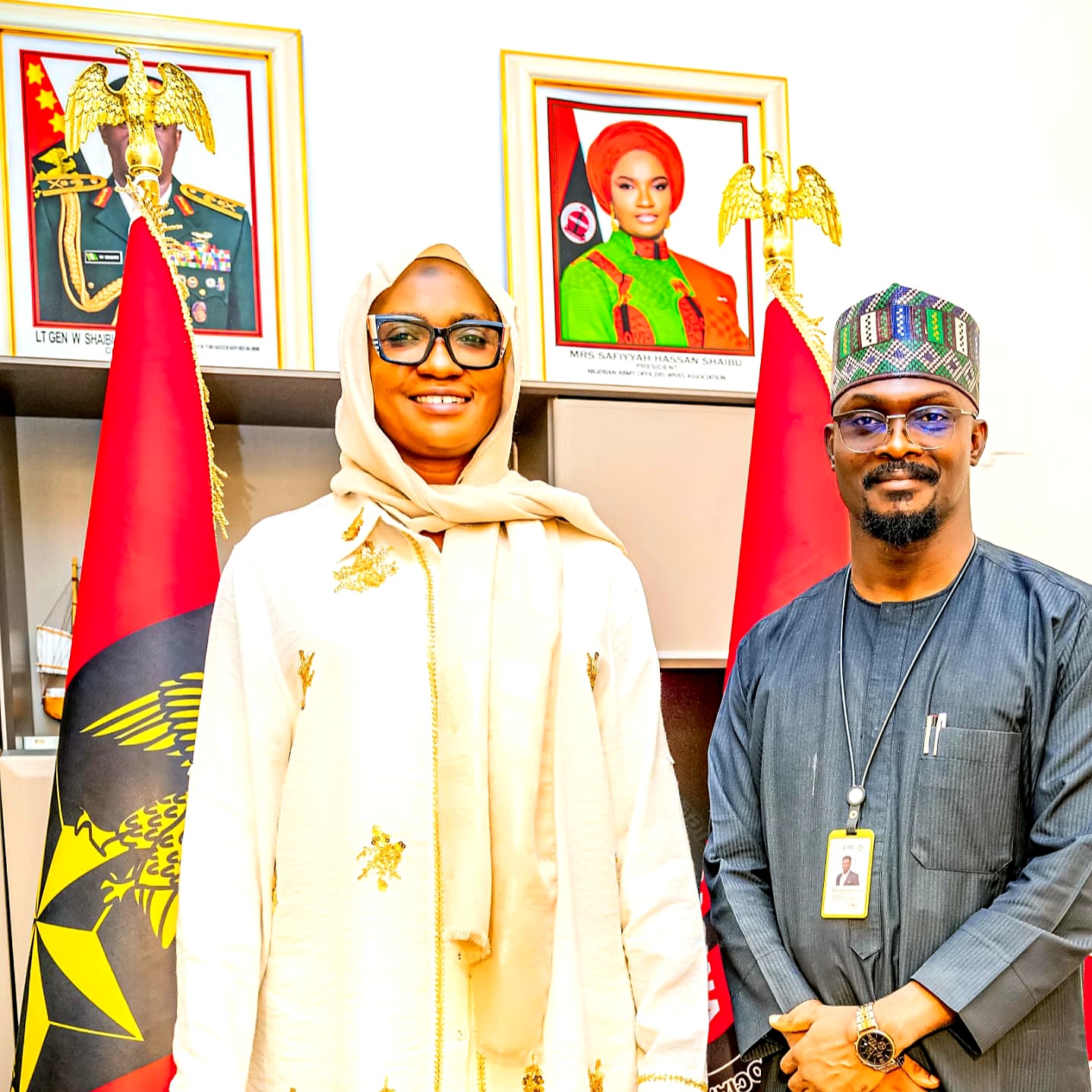
In the premiere edition, the President of UNESCO REF, Prince Abdulsalami Ladigbolu-Oranmiyan, and the President of the Nigerian Army Officers' Wives Association, Hajia Safiyyah Hassan Shaibu, hold the most extensive conversation on record about how Nigeria intends to deliver the Young Women in Agriculture programme, an initiative designed to train and certify twelve million young women in agriculture. Recorded at the Maryam Babangida National Centre for Women Development, Abuja.

Audio available at premiereApproximately 52 minutes · English · Transcript in English and French
Premieres Q2 2027Strand Women and AgricultureRecorded Abuja
IIS1 · E02 · Statecraft

A Working Visit to Westminster: The ABE and UNESCO REF Strategic Partnership

Inside the partnership that opens a route for Nigerian youth to internationally recognised qualifications in business and leadership, and what its launch at Westminster means for Nigerian credentials abroad.

Edition notes
  • PartnerABE, United Kingdom
  • Running timeApproximately 38 minutes
  • TranscriptEnglish and French
Premieres Q2 202738 min
IIIS1 · E03 · Statecraft

Inside the Institutional Mandate: Nigeria's SDG Architecture

Dr. Lateef Olaguju, Secretary-General of the Nigerian National Commission for UNESCO, on the coordinated national framework through which Nigeria pursues its commitments to the Sustainable Development Goals.

Edition notes
  • GuestDr. Lateef Olaguju
  • Running timeApproximately 42 minutes
  • TranscriptEnglish and French
Premieres Q2 202742 min
IVS1 · E04 · Education Finance

The 86 Per Cent Question: Inside the UNESCO REF and UNICAF Educational Financial Facility Scheme

Dr. Nicos Nicolaou, Chief Executive Officer of UNICAF, on the partnership that opens international higher education to Nigerians under SIP-ALPHA through the Educational Financial Facility Scheme.

Edition notes
  • GuestDr. Nicos Nicolaou
  • Running timeApproximately 35 minutes
  • TranscriptEnglish and French
Premieres Q2 202735 min

Running times are approximate and are confirmed at release. The season lineup grows as new conversations are recorded.

III

Voices of Season One

Les voix de la première saison

Season One brings to the microphone leaders who carry direct responsibility for the questions it examines. Each conversation places an institutional mandate on the public record, in the speaker's own words.

Prince Abdulsalami Ladigbolu-OranmiyanI

Prince Abdulsalami Ladigbolu-Oranmiyan

President, UNESCO REF

In conversation onHow Nigeria will deliver the Young Women in Agriculture programme, and the institutional mandate behind it.

Hajia Safiyyah Hassan ShaibuI

Hajia Safiyyah Hassan Shaibu

President, Nigerian Army Officers' Wives Association

In conversation onThe mobilisation of twelve million young women, and the role of national institutions in reaching them.

Dr. Lateef OlagujuIII

Dr. Lateef Olaguju

Secretary-General, Nigerian National Commission for UNESCO

In conversation onThe coordinated national framework through which Nigeria pursues the Sustainable Development Goals.

Dr. Nicos NicolaouIV

Dr. Nicos Nicolaou

Chief Executive Officer, UNICAF

In conversation onOpening international higher education to Nigerians through the Educational Financial Facility Scheme.

Guests confirmed for, or in conversation with, the inaugural season. Further voices are announced as editions are recorded.

IV

Editorial Charter and Production Standard

Charte éditoriale et norme de production

The podcast is held to the principles that govern the world's most respected public-service broadcasters. These commitments apply to every edition and are published so that guests and listeners know the terms on which the programme is made.

01

Accuracy

Exactitude

Every factual statement of consequence is verified against its source before release. Figures are attributed, and where a claim cannot be confirmed, it is identified as the speaker's own.

02

Fairness and Right of Reply

Équité et droit de réponse

Where an edition concerns the conduct of an institution or person not present, that party is offered a reasonable opportunity to respond before publication.

03

Editorial Integrity

Intégrité éditoriale

Editions are edited for clarity and length, never to alter the meaning of what was said. Guests may review the transcript for factual accuracy before release; final editorial decisions rest with the Media Centre.

04

Accessibility

Accessibilité

Each edition is published with show notes, chapter markers and a full transcript in English with a French translation, so that the programme is open to readers and to listeners using assistive technology.

05

Corrections

Rectifications

Errors are corrected openly. A dated correction is added to the edition notes and transcript, and the audio is amended where the error is material.

06

Preservation

Conservation

Every edition, with its transcript, is preserved in the UNESCO REF Media Centre archive as part of the institution's permanent public record.

Production Standard for Season One

Norme technique de la saison une

Recording48 kHz, 24-bit capture, with each speaker recorded on a separate channel
LoudnessMastered to minus 16 LUFS integrated, with true peak no higher than minus 1 dBTP, in line with prevailing streaming practice
Release packageAudio, written show notes, chapter markers, transcript in English and French, and cover art
DistributionAn open RSS feed carried by Apple Podcasts, Spotify, YouTube and Amazon Music, among other platforms
ArchiveMaster files and transcripts held by the UNESCO REF Media Centre, Abuja
V

Papers of the Podcast

Études de référence du programme

Two papers published by UNESCO REF set out the scholarly foundation of the programme: the place of the spoken word in African knowledge, and the role of long-form audio in public trust and development diplomacy.

UNESCO REF Paper No. 1 · The Dispatch

The Spoken Archive: Orality, Public Knowledge and the Place of Long-Form Audio in African Development Discourse

L'archive parlée : oralité, savoir public et place de l'audio de long format dans le discours africain du développement

Author: UNESCO REF · Published by the UNESCO REF Media Centre, Abuja · 2026 · Ten sections across five pages

Abstract

This paper examines the long-form spoken conversation as an instrument of public knowledge in Africa. It traces the authority of orality in African societies, the institutions that kept spoken knowledge accurate across generations, and the methods by which historians came to treat oral testimony as evidence. It then follows the spoken word into the age of broadcasting, considers the linguistic plurality of Nigeria as a condition of public communication, and assesses the return of the long form through podcasting, including the risks that accompany it. The paper concludes with six principles on which an institution may build an archive in sound, and explains how those principles govern The UNESCO REF Podcast.

Keywords orality; oral tradition; public knowledge; broadcasting in Nigeria; podcasting; documentary heritage; development communication

  1. I. Introduction
  2. II. The Authority of the Spoken Word
  3. III. Custodians of Memory
  4. IV. Orality as Evidence
  5. V. Broadcasting and the Making of a Nigerian Public
  6. VI. Language, Plurality and Reach
  7. VII. The Return of the Long Form
  8. VIII. Risks of the Spoken Medium
  9. IX. Principles for an Archive in Sound
  10. X. Conclusion

I. Introduction

Development institutions publish a great deal, and much of what they publish is never fully understood by the people it concerns. Reports appear, communiqués are issued and programmes are launched, yet the reasoning behind a policy often fails to reach the citizen it is meant to serve. The difficulty is seldom a shortage of information. More often it is a shortage of the conditions under which information becomes understanding: sufficient time, adequate context, and a speaker whom the listener can identify and hold to account.

This paper argues that the long-form spoken conversation, recorded, transcribed and preserved, supplies those conditions with particular force in the African setting. The argument rests on history. For most of the continent's past, knowledge of law, lineage, medicine, statecraft and belief was held and transmitted orally, by specialists whose standing depended on accuracy, memory and public performance. A medium that restores the spoken word to the centre of public reasoning therefore addresses African audiences in a register they have long had reason to trust.

The paper proceeds in ten parts. Sections II to IV establish the authority and method of oral knowledge. Sections V and VI consider broadcasting and language in Nigeria. Sections VII and VIII assess podcasting, its promise and its risks. Section IX sets out principles for an institutional archive in sound, and Section X concludes.

II. The Authority of the Spoken Word

Scholarship on African oral literature, beginning in earnest with Ruth Finnegan's survey of 1970 and extended by Isidore Okpewho and others, has shown that orality on the continent is a complete system of knowledge in its own right. Its forms are numerous: genealogical recitation, praise poetry, proverb, epic, court narrative and divinatory verse. Each has conventions of composition and performance, and each is delivered before an audience able to judge whether it has been rendered correctly.

Among the Yoruba, oriki record the attributes and deeds of persons, lineages and towns. Karin Barber's study of oriki in a Yoruba town showed that these texts are not fixed monuments. They are recited, contested and extended, and through them a community conducts an argument with its own past. The Ifa divination system, which UNESCO proclaimed a Masterpiece of the Oral and Intangible Heritage of Humanity in 2005 and inscribed on the Representative List in 2008, preserves a very large corpus of verse that practitioners commit to memory over years of training.

These traditions share a principle that modern institutional communication has tended to lose. Knowledge gains authority when it is spoken by an identifiable person, in public, before listeners competent to question it. In this sense the spoken word has always been an instrument of accountability as well as of transmission.

Page 1 of 5
VI

For Guests and Listeners

Pour les invités et les auditeurs

2009UNESCO REF established in Nigeria
5Distribution platforms at premiere
6Geopolitical zones within editorial reach
2Transcript languages, English and French

Propose a Conversation

Proposer un entretien

The podcast welcomes proposals from leaders in government, diplomacy, education, agriculture, enterprise and culture whose work bears on Nigeria's development and Africa's future. Guests join a programme of institutional standing, professionally produced and published to an international audience.

  • A short biography and current role
  • The question you would address, in one paragraph
  • Your availability for recording in Abuja or remotely
Send a proposal

Be Notified at Premiere

Être informé de la première diffusion

Season One premieres in the second quarter of 2027. Listening links for every platform, together with transcripts and edition notes, will be published on this page on release. Partners, journalists and listeners may ask to be notified when the first edition is available.

  • Premiere notice by email
  • Media access to transcripts on release
  • Partner enquiries on future seasons
Request notification
VII

Questions

Questions fréquentes

When does The UNESCO REF Podcast premiere?

All four editions of Season One premiere in the second quarter of 2027, between April and June. Listening links are published on this page on release.

Where will the podcast be available?

The podcast will be distributed through an open RSS feed carried by Apple Podcasts, Spotify, YouTube and Amazon Music, among other platforms, and will remain available on this page with its transcripts.

Who produces the podcast?

The podcast is produced by the UNESCO REF Media Centre through The Dispatch, its editorial service, in Abuja, Federal Republic of Nigeria. The Media Centre is a registered serial publication bearing EISSN 3156-5557 issued by the National Library of Nigeria.

What does Season One cover?

Season One addresses the Young Women in Agriculture mobilisation campaign, the ABE and UNESCO REF strategic partnership, Nigeria's national architecture for the Sustainable Development Goals, and the UNESCO REF and UNICAF Educational Financial Facility Scheme.

Are transcripts available?

Yes. Every edition is published with a full transcript in English and a French translation, together with show notes and chapter markers.

How can I propose myself as a guest?

Write to [email protected] with the subject Podcast Guest Proposal, including a short biography, the question you would address and your availability for recording.