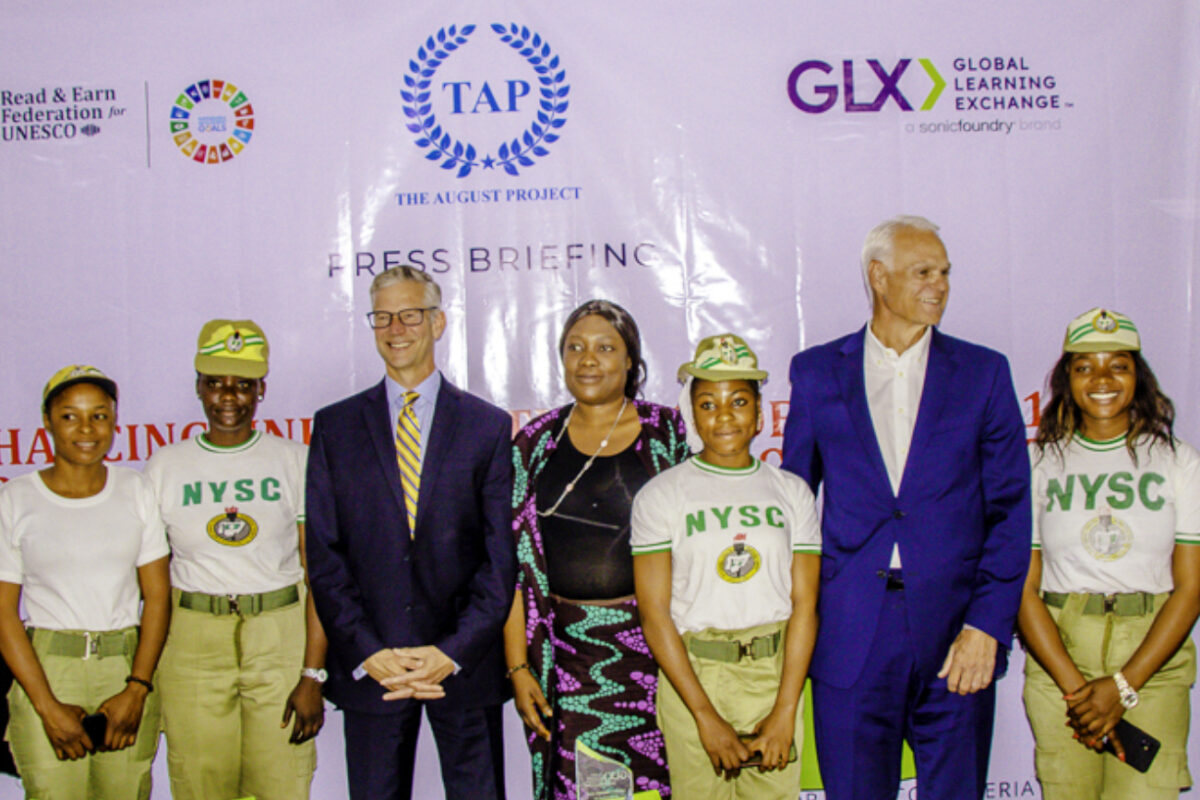
USA, SONIC FOUNDRY PARTNER UNESCO REF TOWARDS EASY ATTAINMENT OF SDGS GOAL $ AND 8 IN NIGERIA

SDGs Global Mission Scheme SGMS, Nigeria Pilot
Overview
SDGs Global Mission Scheme (SGMS) is a three‑year, USD 100 million pilot in Nigeria, led by Sonic Foundry Inc. in partnership with GLX university partners in Australia, the United Kingdom, and the United States. SGMS mobilizes technology, scholarship capital, and public‑private partnerships to expand equitable access to higher education, strengthen youth employability, and build resilient educational infrastructure aligned with the United Nations Sustainable Development Goals. The program is designed to be replicable across emerging economies and to attract multilateral and private sector collaboration.

Objectives and Expected Impact
Primary Objectives
– Expand academic access: Fund Bachelor’s, Master’s, and recognized professional certifications for eligible Nigerian youth through accredited GLX university partners.
– Deploy GLX Hubs: Establish Sonic Foundry GLX Hub facilities offering study spaces, digital access, academic advising, mental health services, and career planning.
– Prioritize girl child education: Direct a larger share of resources to out‑of‑school girls and recent high school graduates to reduce barriers such as early marriage and exploitation.
– Boost employability: Emphasize retention, skills alignment with labor market needs, internships, and international job placement opportunities for top graduates.

Expected Impact
– Contribute to SDG 4, SDG 8, SDG 9, and SDG 17,
– Create measurable human capital gains through increased tertiary enrollment, higher graduation rates, and improved job placement outcomes.
– Deliver a scalable model for public‑private collaboration that can be adapted to other countries.

Program Design and Funding Allocation
Mission Funding: USD 100,000,000 over three years for the Nigeria pilot.
Delivery Model: Scholarships awarded on merit and need; GLX Hubs operated via public‑private partnerships with national ministries, UNESCO REF, the Nigerian Police Force Education Unit, local universities, and employer networks. Performance‑based disbursements and phased rollouts will manage risk and ensure accountability.

Funding Allocation and Program Design

The USD 100 million investment for the Nigeria pilot will be strategically deployed across six priority areas to maximize impact and sustainability:

• Scholarships and Tuition (USD 40 million): Direct financial support for Bachelor’s, Master’s, and professional certification programs through GLX university partners in Australia, the UK, and the USA.
• GLX Hub Capital and Technology (USD 25 million): Establishment of modern learning hubs equipped with advanced audio-visual systems, connectivity, and digital infrastructure to support hybrid learning.
• Operations and Staffing (USD 15 million): Recruitment and training of academic advisors, counsellors, and administrative staff to ensure high‑quality student support services.
• Employability and Placement (USD 10 million): Career services, internship programs, and employer partnerships designed to align graduates with labour market needs and international opportunities.
• Monitoring, Evaluation, and Research (USD 5 million): Independent impact measurement, quarterly reporting, and transparent assessments to ensure accountability and continuous improvement.
• Contingency and Partnerships (USD 5 million): Reserved funds to manage unforeseen risks, strengthen local partnerships, and ensure program resilience.

Governance Safeguards and Partnerships
Governance Structure
– International Steering Committee: Sonic Foundry, GLX university representatives, UNESCO REF, Nigerian government officials, civil society, and independent auditors.
– National Program Office: Responsible for hub rollout, scholarship administration, partner management, and day‑to‑day operations.

Safeguards
– Child protection and gender‑sensitive policies.
– Grievance redress mechanisms and data protection standards.
– Independent midline and endline evaluations and public annual reporting.

Partnerships
– Academic partners: GLX university network in Australia, the UK, and the USA.
– Implementation partners: UNESCO REF, local universities, and private sector employers.

Impact Framework and Key Performance Indicators
Primary KPIs
– Enrollment: Number of scholarship recipients.
– Graduation Rate: Completion rate for degree programs.
– Employment: Placement in formal employment or internships within 12 months of graduation.
– Gender Focus: Share of resources and enrollments for girls and young women.
– Hub Utilization: Attendance and service uptake metrics.

Three Year Targets
– Enrollments: 10,000.
– Graduation Rate: ≥70% for degree programs.
– Employment: ≥60% placed in formal employment or internships within 12 months.
– Gender Allocation: ≥55% of scholarship resources directed to girls and young women.

Measurement Approach
Quarterly dashboards, independent evaluations, alignment with SDG indicators, and transparent public reporting.

Call to Action and Contact
Join the Partnership, SGMS invites UN agencies, bilateral donors, philanthropic foundations, academic institutions, and private sector employers to co‑finance, co‑design, and scale this model. Stakeholders are invited to contribute funding, technical expertise, internship and employment pathways, and local implementation capacity.

UNESCO ANNOUNCES OPEN REGISTRATION FOR NEW ONLINE COURSE ON AI AND THE RULE OF LAW

Artificial Intelligence and the Rule of Law: A Global Training Initiative

Judicial systems worldwide are increasingly adopting Artificial Intelligence (AI) to support legal practitioners in identifying precedents, streamline judicial processes, and assist judges in decision-making related to sentencing and recidivism. While these applications hold promise for efficiency and innovation, they also raise profound implications for human rights, particularly where the opacity of AI systems may challenge the principles of open justice, due process, and the rule of law.

To strengthen capacity in this critical area, UNESCO, in partnership with The Future Society (TFS), has launched a joint online training program on Artificial Intelligence and the Rule of Law. The course was formally introduced on 6 December 2021 at The Athens Roundtable, the premier international, multi-stakeholder forum on AI, legal systems, regulatory compliance, and governance.

Marielza Oliveira, Director in UNESCO’s Communications and Information Sector, emphasized that the societal and human rights impacts of AI demand collective action: “The online course on AI and the Rule of Law is an effort in this direction, with 21 speakers from 14 countries sharing their unique knowledge and experience.”

Nicolas Miailhe, President and Founder of TFS, highlighted the program’s strategic importance: “The course aims to build capacity across judicial stakeholders worldwide so they can be better equipped to navigate AI’s opportunities as well as manage the risks. This is crucial for the responsible adoption of AI.”

Benes Aldana, President of the National Judicial College (United States), reinforced the urgency of early engagement: “The legitimacy of judicial decisions in democratic societies depends on public acceptance of their fairness. It is important for the judiciary to begin early on to build capacity to deal with these rapidly evolving technologies. The Massive Open Online Course (MOOC) is a valuable resource in training judicial operators globally.”

Developed in collaboration with Cetic.br|NIC.br, the National Judicial College (NJC), and IEEE SA, the course engages participants in a timely global dialogue on AI’s application in justice systems. Structured around six introductory modules, participants will explore:

  Why AI matters for justice

  How AI can be responsibly adopted within judicial systems worldwide

  What AI means for human rights

  The evolving role of judicial operators in the age of AI

The program is offered in English, French, Spanish, Russian, Chinese, Arabic, and Portuguese, ensuring broad accessibility. Hosted by the National Judicial College, the course commenced on 14 March 2022 and runs for six weeks, after which it remains available online for self-directed learning. Participants who complete all six modules will receive a Certificate of Course Completion.

This initiative is supported by the Open Society Foundations and the UNESCO Multi-Donor Programme on Freedom of Expression and Safety of Journalists (MDP), underscoring the shared commitment to advancing judicial capacity, safeguarding human rights, and ensuring the responsible integration of AI into justice systems worldwide.


 

UNESCO designates 8 new Global Geoparks

UNESCO Expands Global Geoparks Network with Eight New Designations

The UNESCO Executive Board has approved the designation of eight new UNESCO Global Geoparks, bringing the total number of sites in the Global Geoparks Network to 177 across 46 countries. With this expansion, Luxembourg and Sweden join the Network for the first time, marking their entry into the global community of geoparks.

The UNESCO Global Geopark label, unanimously ratified by Member States in 2015, recognizes geological heritage of international significance. These sites showcase extraordinary geological diversity that underpins the biological and cultural richness of their regions. By combining the conservation of unique geological heritage with public education and sustainable development, geoparks serve as catalysts for local community empowerment and global knowledge exchange.

With the latest designations, the Network now spans a surface area of 370,662 km², comparable to the size of Japan, reinforcing its role as a truly global initiative.

This year’s new designations include two geoparks in Latin America and six in Europe. While COVID‑19 restrictions prevented the evaluation of new applications from Asia, Africa, and the Arab region, several projects are currently underway to expand the Network into these regions in the near future.