
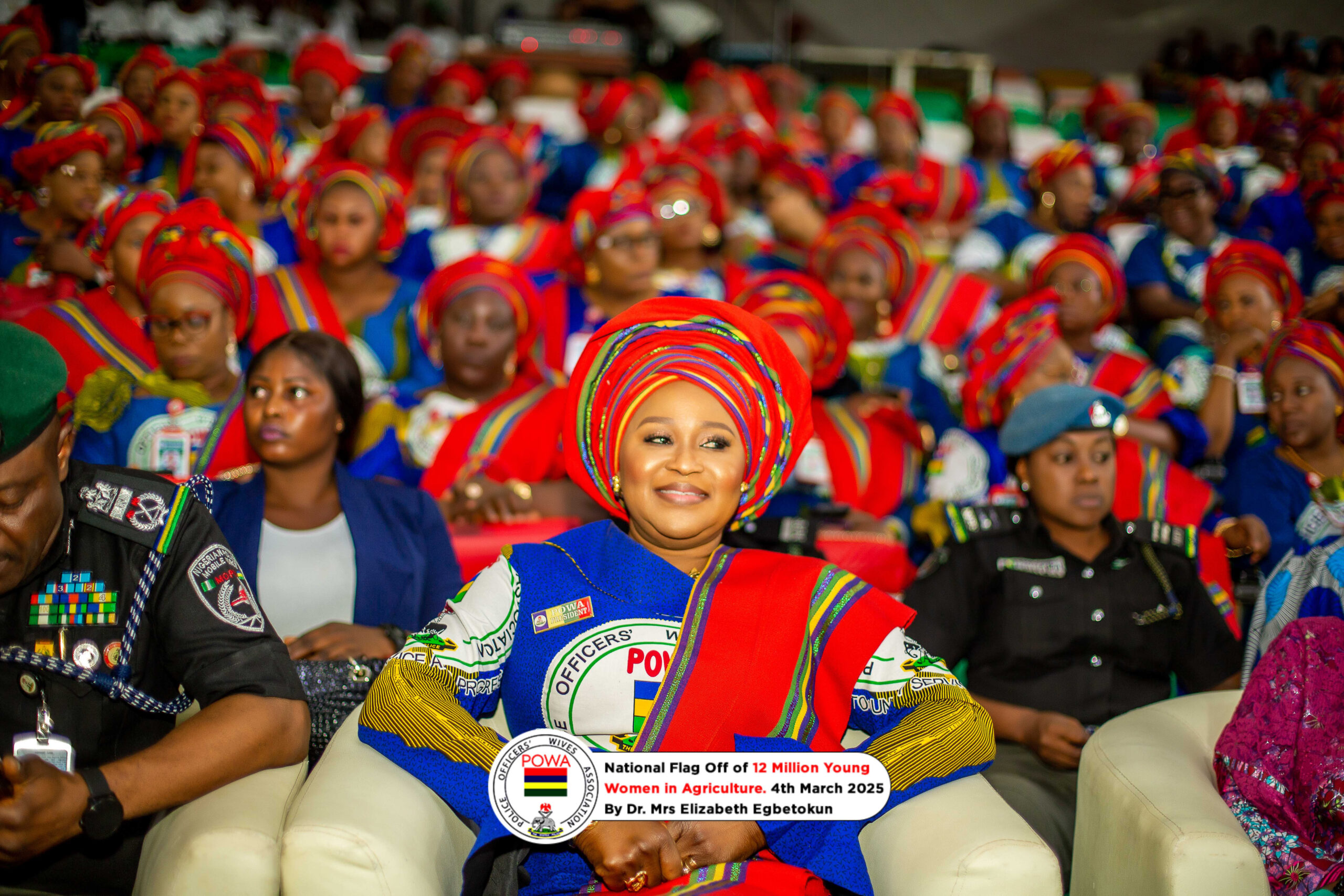

Abstract. This paper examines the proposition, stated repeatedly at the National Flag-Off of the Young Women in Agriculture Mobilisation Campaign on 4 March 2025, that the strength of women is a foundation of household and national prosperity. It treats the proposition not as a sentiment but as a claim to be tested against three bodies of evidence. The first is historical: the record of women's political, military, economic and intellectual authority in the societies that became Nigeria, from Queen Amina of Zazzau and Queen Idia of Benin to Nana Asma'u of Sokoto, the Women's War of 1929 and the Abeokuta Women's Union. The second is economic: the research on who controls income within households, on women's contribution to agricultural labour, and on the gender gap in agricultural productivity. The third is theoretical: the capability approach of Amartya Sen and Martha Nussbaum and the resources, agency and achievements framework of Naila Kabeer. The paper finds that the strength of Nigerian women is well established historically and economically, that its expression is systematically constrained by unequal access to land, finance, time, information and markets, and that the most effective interventions are those which remove specific constraints while building collective organisation. It corrects a widely repeated statistic on women's share of agricultural labour, reviews what interventions have been shown to work, and sets out eight design principles and a set of indicators for the Young Women in Agriculture Programme.
Keywords: women in agriculture; Nigeria; women's history; intrahousehold allocation; gender productivity gap; empowerment; capability approach; agricultural policy
Key findings
- The public authority of women is part of Nigeria's own political inheritance, not a modern import. It has repeatedly been exercised through organisation, and often in defence of economic livelihoods.
- Nigerian women have built durable economic institutions of their own, notably market associations and rotating savings associations, which demonstrate commercial competence and collective discipline.
- The common claim that women produce 60 to 80 per cent of Africa's food is not supported by recent plot-level data. Women's share of crop labour is estimated at about 40 per cent across six African countries, and at about 32 per cent in northern and 51 per cent in southern Nigeria. Their role in processing and trade is larger still.
- Income controlled by women is spent disproportionately on food, health and children's education, a finding replicated across several continents.
- Women farmers are as capable as men but less productive on average because of unequal access to resources. Closing the gap would raise output and reduce hunger at national and global scale.
- Effective programmes remove specific constraints (market access, finance, land security, time, information) and build collective organisation; they also measure empowerment, not only income.
1. Introduction
1. Introduction
At the National Flag-Off of the Young Women in Agriculture Mobilisation Campaign, held at the Maryam Babangida National Centre for Women Development in Abuja on 4 March 2025, speaker after speaker returned to a single idea. The National President of the Police Officers' Wives Association described the campaign as a covenant with the Nigerian woman "as a sovereign actor in the agricultural economy". The Honourable Minister of Women Affairs declared that when women are empowered, families are stronger and communities safer. The National Coordinator spoke of the strength, resilience and determination of Nigerian women. The Deputy Secretary-General of the United Nations compressed the argument into a sentence: every woman empowered is a community strengthened, every girl educated is a nation advanced.
Statements of this kind are familiar on International Women's Day, and their familiarity can make them seem ceremonial. This paper takes them seriously as propositions about the world. It asks four questions. First, what historical evidence supports the claim that Nigerian women have exercised strength in public, economic and political life? Second, what does economic research show about the consequences of women's income and productive activity for households and nations? Third, under what constraints is that strength exercised, and how large are the losses those constraints impose? Fourth, what follows for the design of a programme that proposes to mobilise twelve million young women into agricultural enterprise?
The questions matter because the design of public policy follows from its premises. A programme that regards women as vulnerable recipients will distribute assistance and measure its success by what it gives. A programme that regards women as capable agents held back by identifiable constraints will remove those constraints and measure its success by what women achieve. The two approaches produce different budgets, different institutions and different results. The Young Women in Agriculture Programme is founded on the second premise. This paper sets out the evidence for that premise, identifies where popular versions of it are inaccurate, and draws the design implications with as much precision as the evidence allows.
The paper proceeds as follows. Section 2 describes the approach and sources. Section 3 clarifies what is meant by strength. Sections 4 and 5 establish the historical record of women's authority and economic institutions in Nigeria. Section 6 examines women's role in Nigerian agriculture today, including the measurement of women's labour. Sections 7 and 8 review the evidence on income control and the productivity gap. Section 9 examines the constraints under which women's strength is exercised. Section 10 introduces the theoretical frameworks that connect strength to capability. Section 11 reviews what interventions have been shown to work. Section 12 draws the implications for the Young Women in Agriculture Programme, Section 13 sets out limitations and a research agenda, and Section 14 concludes.
2. Approach and sources
2. Démarche et sources
This is a structured review of existing scholarship, not a report of new primary data. It draws on four literatures that are rarely read together: the historiography of women in Nigerian and West African societies; the economics of the household and of intrahousehold allocation; agricultural economics, particularly the measurement of labour and productivity by gender; and the theory and measurement of empowerment. The review privileges peer-reviewed studies, major institutional reports of the Food and Agriculture Organization of the United Nations and the World Bank, and established monographs. Where findings are contested, the paper says so. Where a popular statistic is not supported by the evidence, the paper identifies the better estimate.
Three limitations should be noted at the outset. First, historical sources on precolonial women leaders are uneven: some figures are documented in contemporary records, others are known mainly through oral tradition, and chronologies are sometimes uncertain. The paper treats traditions as evidence of how societies remember and value women's authority, while noting where dates or details are disputed. Second, much of the economic evidence comes from countries other than Nigeria; the paper relies on it where its mechanisms are general and identifies Nigerian evidence wherever it exists. Third, Nigeria is a country of great regional, religious and cultural diversity. Generalisations about "the Nigerian woman" are made with caution, and regional differences are noted where they matter.
3. What is meant by strength
3. Ce que l'on entend par force
The word strength is used in public speech in at least three senses, and conflating them leads to poor policy. The first is endurance: the capacity to bear hardship, to keep a household fed in a lean season, to absorb shocks. The second is capability: the capacity to produce, to decide, to organise and to lead. The third is authority: recognised standing in the institutions of a community, whether a market, a council or a state.
Much celebration of women's strength refers to the first sense. Endurance deserves respect, but it is an ambiguous basis for policy. A society that relies on women's endurance may simply be transferring to women the costs of its own failures, and praising them for absorbing those costs. Feminist economists have long warned against this, noting that the resilience of women in crises often reflects the extra unpaid work they undertake when public services and incomes fail.
This paper therefore concentrates on the second and third senses. It asks what women have been able to do and to direct when the conditions allowed, and what prevents them from doing more. In the language of Section 10, it is concerned less with how much women can bear than with the resources they command, the agency they exercise and the achievements that result. The distinction is not academic. A programme built on endurance asks women to do more with less. A programme built on capability gives women the means to do more, and expects them to do so.
One further clarification is needed. To speak of women's strength is not to claim that women are morally superior to men or uniformly alike. The evidence reviewed in Section 7, for example, shows that women tend to spend income differently from men; it does not show that this reflects an innate disposition. It reflects responsibilities, social expectations and bargaining positions, all of which vary across households and change over time. The case for investing in women rests on evidence about consequences, not on essentialist claims about character.