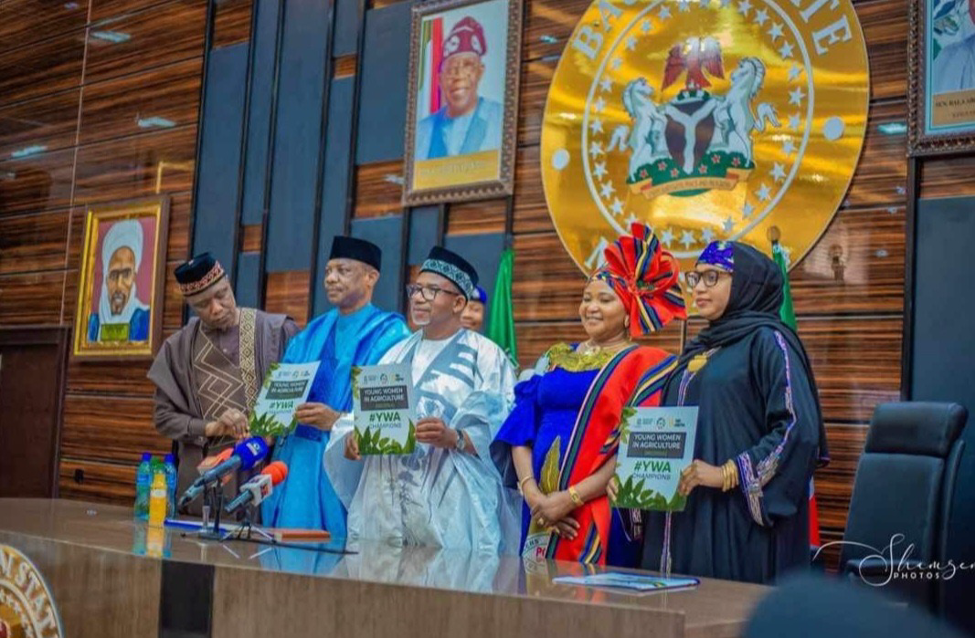
The National Advocate for the UNESCO REF Young Women in Agriculture, Dr. (Mrs.) Elizabeth Egbetokun, conducted a working visit to His Excellency Senator Bala Abdulkadir Mohammed, Governor of Bauchi State, to formalise and accelerate collaboration for the strategic mobilisation, capacity building and economic empowerment of young women in agriculture across the state. The engagement advances shared commitments to gender equality, sustainable agriculture and inclusive rural development, in line with national priorities and global development frameworks. Read Full Story at the Media Centre.
The Maryam Babangida National Centre for Women Development (NCWD) has been officially designated as the National Secretariat for the UNESCO REF Young Women in Agriculture (YWA) Programme. This landmark designation underscores NCWD’s pivotal role in advancing UNESCO REF’s mission to empower young women through agricultural innovation, skills development, and sustainable livelihood opportunities. It also reflects Nigeria’s leadership in promoting women’s development and positions NCWD as a central hub for driving impactful initiatives nationwide.
Advocacy and Institutional Leadership
This milestone was facilitated through the tireless advocacy of Dr. Mrs. Egbetokun, UNESCO REF YWA National Advocate and President of the Police Officers’ Wives Association (POWA). Her engagement with stakeholders ensured that the request was properly advanced and aligned with Nigeria’s broader vision for women’s empowerment and agricultural transformation.
NCWD’s Commitment to National Mandate
The designation was formally approved by Hon. Vilita Asabe, Director‑General of NCWD, who emphasized the Centre’s readiness to assume this national mandate. In her words: “This recognition by UNESCO REF is both an honor and a responsibility. As the National Secretariat, NCWD will serve as the hub for innovation, collaboration, and empowerment. We are committed to ensuring that young women across Nigeria have access to the skills, mentorship, and opportunities they need to thrive in agriculture and beyond. This is a defining moment for women’s development in our country.”
Programme Implementation and Impact
As the National Secretariat, NCWD will coordinate programme implementation, foster stakeholder collaboration, and ensure alignment with national and international frameworks for women’s empowerment and sustainable development. The YWA Programme seeks to strengthen the participation of young women in agriculture by providing access to training, mentorship, and modern technologies, while promoting inclusive growth and food security. By empowering young women to become leaders in agriculture, the programme contributes directly to poverty reduction, economic diversification, and community resilience.
Shared Commitment to Global Goals
Through this partnership, NCWD and UNESCO REF reaffirm their shared commitment to advancing gender equality, enhancing economic opportunities, and contributing to the achievement of the United Nations Sustainable Development Goals (SDGs). The designation of NCWD as the National Secretariat is more than an announcement – it is a national commitment to inclusive growth, global solidarity, and a future where women stand at the forefront of Nigeria’s socio‑economic transformation.
On the morning of 12 August 2024, the Nigeria Police Force and UNESCO REF convened a landmark youth summit in Abuja to mark the United Nations International Youth Day. The gathering drew government officials, security agencies, civil society organisations and youth leaders from every corner of the federation, and set out to reimagine the relationship between young Nigerians and the institutions charged with their security. Read Full Story at the media Centre.
Strategic Collaboration for Education and Skills Development: UNESCO REF and Global Learning Exchange, USA.
Introduction
Two million Nigerian are denied higher education access due to insufficient enrollment capacity, a gap UNESCO REF and the Global Learning Exchange are committed to bridging; because education is universally recognized as the foundation of sustainable development, social mobility, and global competitiveness.
In the 21st century, nations that invest in human capital through accessible, high‑quality education and skills development are best positioned to thrive in an interconnected world. Against this backdrop, the UNESCO REF partnered with the Global Learning Exchange™ (GLX) under the NEPAD_EY framework, implemented through the TAP Category 2.9 platform.
This collaboration represents a bold institutional step toward democratizing education, bridging Nigeria’s intellectual capital with global opportunity, and advancing the United Nations Sustainable Development Goals (SDGs).
Global and Continental Context
The partnership is not an isolated initiative but part of a broader agenda. It aligns with:
UNESCO’s global mandate to promote inclusive and equitable quality education.
African Union Agenda 2063, which emphasizes skills development, youth empowerment, and innovation as drivers of continental transformation.
NEPAD_EY’s strategic frameworks, which prioritize education and employment as pillars of Africa’s sustainable growth.
By situating Nigeria within these global and continental frameworks, the collaboration underscores the country’s role as a hub for educational innovation and human capital development in Africa.
Vision and Institutional Framework
Operating under the UNESCO REF Strategic Implementation Platform (SIP‑ALPHA), the partnership reflects a deliberate alignment of two organizations committed to democratizing education. The vision is clear: every qualified Nigerian youth, regardless of geography or economic circumstance, should have access to world‑class education and professional opportunities.
The initiative delivers internationally accredited academic programmes, professional certifications, and digital skills development. These opportunities are structured to advance SDG 4 (Quality Education), SDG 8 (Decent Work and Economic Growth), and SDG 17 (Partnerships for the Goals), ensuring that the collaboration contributes meaningfully to both national and global development agendas.
Infrastructure and Access
A cornerstone of the initiative is the establishment of GLX Hub facilities across Nigeria’s six geopolitical zones. These hubs will provide:
Modern learning environments equipped with laptops, high‑speed internet, and e‑libraries.
Academic guidance, counselling, and mental health services.
A supportive study environment that enables participants to matriculate and graduate with leading GLX university partners in the United States, United Kingdom, Canada, and Australia.
This infrastructure ensures that Nigerian youth are not only educated but also globally connected.
Employment and Human Capital Development
Beyond education, the initiative addresses employment. Each GLX Hub will generate jobs for qualified local professionals, who will manage operations and provide academic and administrative support. This model strengthens institutional capacity, creates local ownership, and ensures sustainability.
Career Support and Mental Wellbeing
Recognizing that education must be holistic, the hubs will deliver wraparound services including career planning, counselling, and mental health support. By prioritizing student retention, employability, and long‑term success, the initiative ensures that participants are prepared not only academically but also personally and professionally.
Knowledge and Technology Transfer
The collaboration emphasizes knowledge and technology transfer through structured training and certification programs. This ensures that expertise is localized, institutional capacity is built, and Nigeria becomes a hub for educational innovation.
The GET EDUCATED Pathway
Branded as GET EDUCATED, the pathway symbolizes the institutional commitment to bridging Nigeria’s intellectual capital with global opportunity. It targets youth between 18 and 35; including NYSC corps members, graduates, and young professionals — and provides access to internationally validated programmes. By doing so, it creates a pipeline of globally competitive graduates who can contribute to national development and international collaboration.
Conclusion
The UNESCO REF and GLX partnership is more than an educational program; it is a strategic investment in Nigeria’s future and Africa’s transformation. By combining infrastructure, employment, career support, and knowledge transfer, the collaboration creates a holistic ecosystem for learning and growth. Anchored in global best practices and aligned with the SDGs, it represents a transformative pathway for Nigerian youth to thrive in an interconnected world.
ABE are proud to be partners with UNESCO-Ref on the TAP project in Nigeria, which aims to empower 1.2m young people with high-impact entrepreneurial skills. Helping them find decent work or start their own business, reducing the massive unemployment and poverty crisis.