
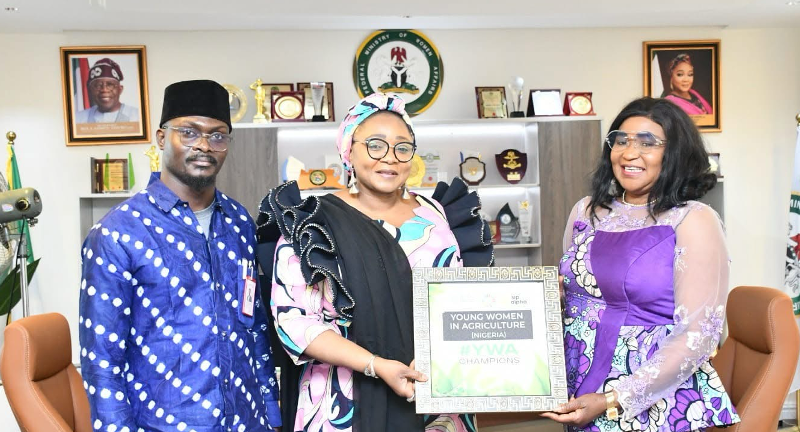
UNESCO REF President and YWA National Advocate Hold Working Visit with Minister of Women Affairs on Food Security through Young Women in Agriculture
UNESCO REF Media Centre | Young Women in Agriculture
The Federal Ministry of Women Affairs and UNESCO REF agree joint action frameworks to roll out the Young Women in Agriculture programme and the national campaign to mobilise 12 million young women.
ABUJA, Nigeria. In furtherance of the national effort to secure Nigeria’s food future through the empowerment of its young women, the President of the Read and Earn Federation for UNESCO (UNESCO REF), Prince Abdulsalami Ladigbolu-Oranmiyan, accompanied by Dr Mrs Elizabeth Egbetokun, National Advocate of the UNESCO REF Young Women in Agriculture (YWA) programme and then National President of the Police Officers’ Wives Association (POWA), paid a working visit to the Honourable Minister of Women Affairs, Hajiya Imaan Sulaiman-Ibrahim. The meeting finalised the modalities for implementing YWA and for the National 12 Million Mobilisation Campaign.
Global alignmentAlignement mondialThe global commitments this story advances. Open to see how.
- SDG2
SDG 2, Zero Hunger (primary)
ProvisionTarget 2.3: double the productivity and incomes of small-scale producers, in particular women
How the partnership respondsNational mobilisation of young women in agriculture
- SDG5
SDG 5, Gender Equality
ProvisionTarget 5.5: women’s full participation and leadership; Target 5.a: equal rights to economic resources
How the partnership respondsWomen’s empowerment built into agricultural policy
- SDG1
SDG 1, No Poverty
ProvisionTarget 1.4: equal rights to economic resources
How the partnership respondsIncome opportunities for young women
- SDG17
SDG 17, Partnerships
ProvisionTarget 17.17: public and civil society partnerships
How the partnership respondsJoint action frameworks between a federal ministry and UNESCO REF
- MP
Maputo Protocol
ProvisionArticle 15: right to food security
How the partnership respondsWomen at the centre of national food security
- AU
African Union Agenda 2063
ProvisionAspiration 6: development driven by women and youth
How the partnership respondsYoung women as drivers of agricultural transformation
- RHA
Renewed Hope Agenda
ProvisionFood security as a national priority
How the partnership respondsSupports the Federal Government’s food security agenda
The engagement brought together the federal ministry charged with the advancement of Nigerian women and the civil society institution leading one of the country’s largest mobilisations of women in agriculture. Its purpose was practical: to agree how the two institutions would work together to translate national policy into opportunity for young women in every geopolitical zone.
A national priority
Une priorité nationale
The visit took place against the Federal Government’s declaration of food security as a national priority under the administration of President Bola Ahmed Tinubu, and alongside the First Lady’s Food Bank Initiative, which addresses hunger among vulnerable groups. The YWA programme places young women at the centre of that national effort, with a target of 12 million women, two million in each of Nigeria’s six geopolitical zones.
The case for doing so is compelling. The Food and Agriculture Organization of the United Nations reports a 24 per cent gender gap in productivity between women and men farmers on farms of equal size, and finds that closing the gender gaps in agrifood systems would raise global GDP by nearly US$1 trillion and reduce the number of food-insecure people by 45 million. In Nigeria, where the Cadre Harmonisé analysis projected that about 34.7 million people would face food insecurity in the 2026 lean season, the empowerment of women farmers is a matter of national resilience.
Perspectives of the delegation
Points de vue de la délégation
Prince Ladigbolu-Oranmiyan presented the YWA programme and the 12 Million Mobilisation Campaign as national platforms for empowerment and resilience, capable of positioning Nigeria as a continental leader in food security. He anchored both initiatives in the Sustainable Development Goals, in particular Goal 1 on ending poverty and Goal 2 on ending hunger.
Dr Mrs Egbetokun underscored the importance of integrating women’s empowerment and youth mobilisation into agricultural policy. She welcomed the Ministry’s readiness to support the expansion of training, the mobilisation of resources and outreach to communities across the Federation.
Agreed outcomes
Résultats convenus
The meeting concluded with three commitments:
- Joint action frameworks to guide the rollout of the YWA programme across the States.
- Strengthened institutional collaboration between UNESCO REF and the Federal Ministry of Women Affairs.
- Partner mobilisation in support of the YWA programme and the 12 Million Mobilisation Campaign.
Significance
Portée
The engagement marks the alignment of a federal ministry with a civil society programme of national scale. By bringing the Ministry’s policy mandate together with UNESCO REF’s delivery architecture and POWA’s grassroots reach, the partnership creates a pathway through which the empowerment of young women can contribute directly to Nigeria’s food security.
ENDS
Notes to editorsNotes aux rédactions
About Young Women in Agriculture (YWA). YWA is a UNESCO REF flagship programme under the SIP-ALPHA framework that equips young women aged 18 to 35 with agribusiness education, certification and income opportunities, with a national target of 12 million women.
About UNESCO REF. The Read and Earn Federation for UNESCO (UNESCO REF) works to strengthen human and institutional capacity across Nigeria and Africa through education, research and professional development, in alignment with the 2030 Agenda for Sustainable Development.
Media enquiries. UNESCO REF Media Centre, [email protected]
SourcesSources
- Women’s equality in agrifood systems could boost the global economy by $1 trillion, FAO, 13 April 2023
- 12 million YWA Champion mobilisation campaign flag-off, Daily Trust, March 2025
- Young Women in Agriculture, UNESCO REF
- 34.7m Nigerians projected to face food crisis in mid-2026, Daily Trust, 8 November 2025