
Child Labour: Nigeria’s Forgotten Pipeline to Terrorism
UNESCO REF Media Centre | Opinion
Nearly 25 million Nigerian children are in child labour. Every one of them is a child diverted from the classroom, and some will be diverted into conflict. Protecting them is not only a moral duty. It is a matter of national security.
Democracy Day and a sobering reality
La Journée de la Démocratie face à une réalité préoccupante
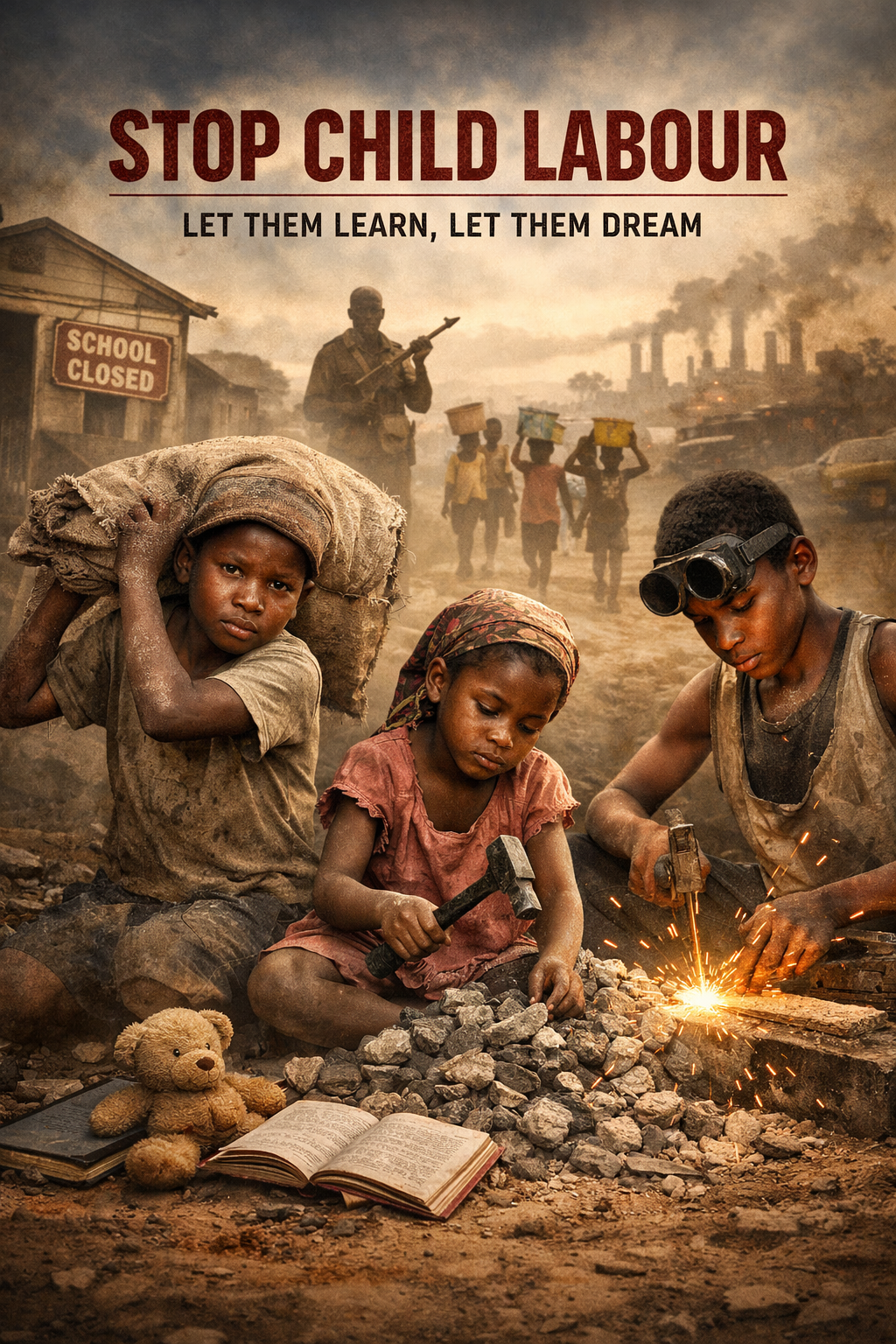
Nigeria marks Democracy Day on the same date the world observes the World Day Against Child Labour. The coincidence should prompt reflection. Child labour is not merely an economic or social problem. It is a national security crisis.
Global alignmentAlignement mondialThe global commitments this story advances. Open to see how.
- SDG8
SDG 8, Decent Work (primary)
ProvisionTarget 8.7: end child labour in all its forms by 2025, including the recruitment and use of child soldiers
What it demands of NigeriaRecover lost ground on a deadline the world has missed
- SDG4
SDG 4, Quality Education
ProvisionTarget 4.1: free, equitable and quality primary and secondary education for all
What it demands of NigeriaReturn out-of-school children to learning
- SDG16
SDG 16, Peace, Justice and Strong Institutions
ProvisionTarget 16.2: end abuse, exploitation and all forms of violence against children
What it demands of NigeriaIntegrate child protection into security strategy
- SDG1
SDG 1 and SDG 17
ProvisionSocial protection systems; multi-stakeholder partnerships
What it demands of NigeriaSafety nets for vulnerable families, and partnership with the international community
- CRC
UN Convention on the Rights of the Child
ProvisionArticle 32: protection from economic exploitation; Article 38: protection in armed conflict
What it demands of NigeriaEnforce both protections together
- CRC
Optional Protocol on the involvement of children in armed conflict
ProvisionProhibits the recruitment and use of children in hostilities
What it demands of NigeriaClose the recruitment pipeline
- ILO
ILO Conventions 138 and 182
ProvisionMinimum age for employment; elimination of the worst forms of child labour
What it demands of NigeriaEnforce the conventions Nigeria has ratified
- AU
African Charter on the Rights and Welfare of the Child
ProvisionArticle 15: child labour; Article 22: armed conflicts
What it demands of NigeriaRegional accountability for both
- DCA
Durban Call to Action, 2022
ProvisionGlobal commitments from the 5th Global Conference on the Elimination of Child Labour
What it demands of NigeriaAccelerate action after the missed 2025 target
- NG
Child’s Rights Act, 2003 (Nigeria)
ProvisionDomestic protection of children from exploitative labour
What it demands of NigeriaFull adoption and enforcement in every State
Children forced into labour, hawking on our streets, working in unsafe mines or performing hazardous tasks, are denied education and hope. Extremist groups exploit that vulnerability and turn poverty into a recruitment pipeline. Every child lost to labour is a child diverted from the classroom towards conflict, from innovation towards insurgency.
The scale of the crisis
L’ampleur de la crise
The figures leave no room for complacency. According to the National Bureau of Statistics, 24.7 million Nigerian children aged 5 to 17, or 39.2 per cent of that age group, were in child labour in 2022. More than 14.3 million of them were engaged in hazardous work.
| Measure | Nigeria | World |
|---|---|---|
| Children in child labour | 24.7 million (39.2% of children aged 5 to 17, 2022) | Nearly 138 million (2024) |
| Children in hazardous work | 14.4 million (22.9%, 2022) | Around 54 million (2024) |
| Regional share | Nigeria is part of sub-Saharan Africa | Around 87 million, nearly two-thirds of the global total, are in sub-Saharan Africa |
| Out-of-school children and youth | About 20 million |
The world has also missed its own deadline. Target 8.7 of the Sustainable Development Goals committed every nation to end child labour in all its forms by 2025. The International Labour Organization and UNICEF confirmed in June 2025 that the target was not met.
From labour to recruitment
Du travail au recrutement
The link between deprivation and violence is not speculation. UNICEF reported in 2022 that more than 8,000 girls and boys had been recruited and used by armed groups in north-east Nigeria since 2009. A 2023 UNDP study of violent extremism in sub-Saharan Africa found that about a quarter of voluntary recruits cited job opportunities as the main reason for joining.
A child who is out of school and working for survival is the child most exposed to that offer. Child labour and terrorist recruitment draw on the same conditions: poverty, exclusion and the absence of hope. They must be confronted together.
Nigeria’s greatest resource at risk
La plus grande ressource du Nigéria en péril
Nigeria’s greatest resource is not oil or minerals. It is its people. Child labour steadily erodes that foundation, diminishing the nation’s intellectual capital and weakening its capacity to compete in a knowledge-driven world. Protecting children today is therefore not only a moral duty but a strategic imperative for Nigeria’s survival and growth.
Democracy is built on participation, inclusion and opportunity. Child labour undermines each of these principles by silencing millions of voices before they can be heard. A democracy that fails to protect its children is a democracy at risk.
Linking the fight to global commitments
Une lutte inscrite dans les engagements mondiaux
Nigeria has already bound itself, in law and in international undertakings, to end child labour and to protect children from armed conflict. What is required now is implementation.
A call to leadership and partnership
Un appel au leadership et au partenariat
At this critical juncture, I call upon His Excellency, President Bola Ahmed Tinubu, to bring fresh, integrated thinking to bear on this crisis by synchronising the work of three ministries: the Federal Ministry of Art, Culture, Tourism and the Creative Economy; the Federal Ministry of Information and National Orientation; and the Federal Ministry of Humanitarian Affairs and Poverty Reduction. The instruments for a solution already lie within their mandates. Cultural renewal, public information and humanitarian outreach must work as one strategy rather than three.
This work must be entrusted to thinkers and specialists with the depth and the time to design durable strategy, and not left solely to administrators absorbed by the demands of daily operations. It must also be strengthened by cooperation between the Global North and the Global South, in recognition that child labour and terrorism are shared challenges that require shared solutions. Nigeria’s call is not for charity but for partnership: a partnership that secures democracy and safeguards humanity.
Nigeria cannot confront this challenge alone. United Nations agencies, donor bodies and international partners must join hands with Nigeria to eradicate child labour and dismantle the recruitment pipelines of terror. That partnership must deliver:
- Investment in education. Schools built, teachers trained and quality learning within reach of every child.
- Social protection. Safety nets for the families most vulnerable to child labour.
- Child-centred security. Counter-terrorism strategies that integrate child protection into national and regional security frameworks.
- Community resilience. Programmes that equip local leaders and families to resist extremist recruitment.
The eradication of child labour is not a distant goal; it is an urgent necessity. Nigeria must strengthen its laws, enforce accountability and treat education as a national security strategy. International partners must provide technical expertise, funding and solidarity. Civil society must continue to raise awareness and hold leaders to account. Government, the private sector, civil society and international organisations must work hand in hand. The stakes are too high for complacency.
The measure of our humanity
La mesure de notre humanité
On this Democracy Day, let us affirm that democracy is measured not by ballots alone, but by the futures we safeguard for our children. The fight against child labour is inseparable from the fight against terrorism. By protecting Nigeria’s children, we protect Nigeria’s democracy and, by extension, the stability of Africa and the world.
The time to act is now. The world must not look away. Nigeria’s children deserve more than survival; they deserve the chance to thrive, to innovate and to lead. The measure of our collective humanity will be judged by how we respond to this crisis.
Notes to editorsNotes aux rédactions
About the author. Prince Abdulsalami Ladigbolu-Oranmiyan is President of the Read and Earn Federation for UNESCO (UNESCO REF) and a Senior Fellow of the Association of Business Executives, United Kingdom. Read his profile.
SourcesSources
- Children in child labour stood at 39.2% in 2022, NBS, News Agency of Nigeria, 19 April 2024
- Nigeria Child Labour Survey 2022, National Bureau of Statistics
- Despite progress, child labour still affects 138 million children globally, ILO and UNICEF, June 2025
- UNICEF calls for end to recruitment and use of child soldiers, UNICEF Nigeria, 14 February 2022
- Lack of jobs, the main driver of violent extremism in sub-Saharan Africa, UN News, February 2023
- UNESCO: Estimated number of out-of-school children in Nigeria now 20m, ThisDay, 2 September 2022
- Tinubu sacks five ministers, reassigns ten, appoints seven new ones, AllAfrica, October 2024