
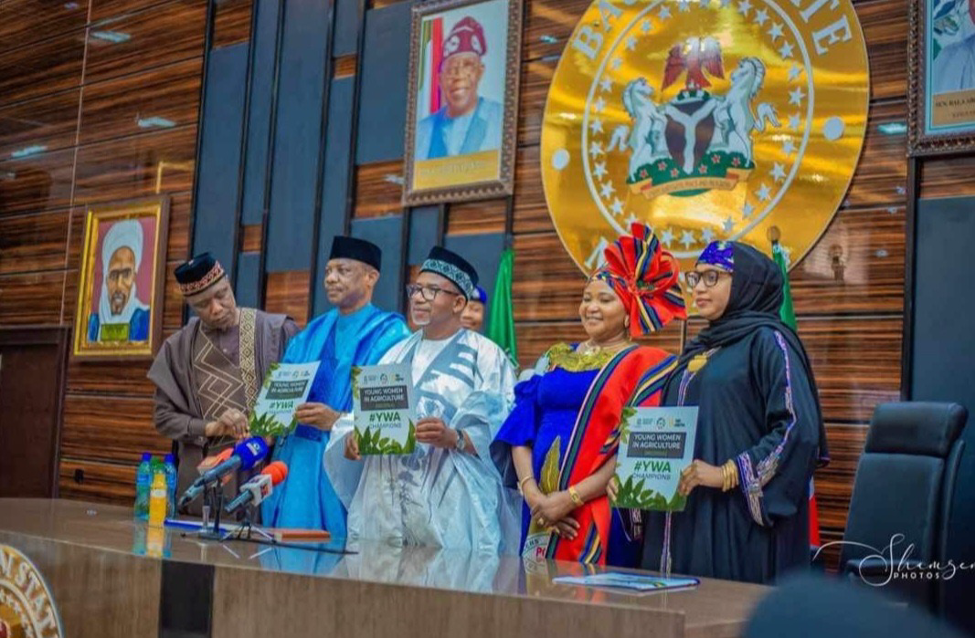
YWA National Advocate Dr Mrs Elizabeth Egbetokun Strengthens Strategic Partnership with Bauchi State Government and Governor Senator Bala Abdulkadir Mohammed on Young Women in Agriculture
UNESCO REF Media Centre | Young Women in Agriculture
Bauchi State commits to the mobilisation, capacity building and economic empowerment of young women in agriculture, with women from every one of its 20 local government areas to be trained, in a partnership that extends the programme into the North East.
Follow this story and the latest updates on the Young Women in Agriculture programme at the UNESCO REF Media Centre.
BAUCHI, Nigeria, 16 April 2024. Dr Mrs Elizabeth Egbetokun, National Advocate of the UNESCO REF Young Women in Agriculture (YWA) programme and National President of the Police Officers’ Wives Association (POWA), has paid a working visit to the Governor of Bauchi State, His Excellency Senator Bala Abdulkadir Mohammed. The visit formalised and accelerated collaboration between UNESCO REF, POWA and the Bauchi State Government on the strategic mobilisation, capacity building and economic empowerment of young women in agriculture across the State.
Global alignmentAlignement mondialThe global commitments this story advances. Open to see how.
- SDG2
SDG 2, Zero Hunger (primary)
ProvisionTarget 2.3: double the productivity and incomes of small-scale producers, in particular women
How the partnership respondsTraining, certification and income for young women in agriculture
- SDG5
SDG 5, Gender Equality
ProvisionTarget 5.5: women’s leadership; Target 5.a: equal rights to economic resources
How the partnership respondsYoung women as leaders of food production
- SDG1
SDG 1, No Poverty
ProvisionTarget 1.4: equal rights to economic resources
How the partnership respondsIncome opportunities for participants
- SDG8
SDG 8, Decent Work
ProvisionTarget 8.6: reduce youth not in employment, education or training
How the partnership respondsAgribusiness employment for women aged 18 to 35
- MP
Maputo Protocol
ProvisionArticle 15: right to food security
How the partnership respondsWomen at the centre of national food security
- AU
African Union Agenda 2063
ProvisionAspiration 6: development driven by women and youth
How the partnership respondsYoung women as drivers of agricultural transformation
- SDG10
SDG 10, Reduced Inequalities
ProvisionTarget 10.2: inclusion irrespective of sex or location
How the partnership respondsExtends the programme to women in Northern Nigeria
- SDG17
SDG 17, Partnerships
ProvisionTarget 17.17: public and civil society partnerships
How the partnership respondsA partnership between a State Government, UNESCO REF and POWA
The engagement reflects a shared commitment to gender equality, sustainable agriculture and inclusive rural development, and a common conviction that the women who sustain Nigeria’s farms must be equipped to lead them. It aligns the work of the State Government with national priorities on food security and with the global development frameworks to which Nigeria is committed.
A homecoming with a mandate
Un retour aux sources porteur d’un mandat
The visit carried particular meaning. Bauchi is Dr Mrs Egbetokun’s home State, and her return to launch the programme there signalled a personal as well as an institutional commitment to the women of the North East. It also marked an important step in extending the programme into Northern Nigeria, where the participation of women in formal agricultural programmes faces distinct social and practical barriers, and where the potential gains are correspondingly great.
The Governor’s commitment
L’engagement du Gouverneur
Governor Bala Mohammed commended Dr Mrs Egbetokun for her leadership in empowering women in agriculture, observing that the initiative would improve food security, raise productivity, create jobs and reduce poverty in the State. He praised the leadership of the Nigeria Police Force for supporting the effort and pledged that Bauchi State would make the fullest use of the programme.
In a constructive intervention, the Governor called for operational arrangements that would make it easier for more women from the northern States to take part, taking due account of the region’s social, cultural and religious context. His observation reflects a principle that the programme has since embraced: that inclusion must be designed, not assumed.
Reaching every local government area
Atteindre chaque collectivité locale
Under the programme, one woman from each of Bauchi State’s 20 local government areas was to be selected, trained and sponsored for agricultural training in the United States. Dr Mrs Egbetokun urged the women of the State to take full advantage of the opportunity.
The approach is deliberate. By drawing participants from every local government area rather than from the State capital alone, the programme ensures that its benefits reach rural communities across Bauchi, where agriculture is the mainstay of household livelihoods.
Why it matters
Les enjeux
Women are central to Nigeria’s food systems, yet they farm at a structural disadvantage. The Food and Agriculture Organization of the United Nations reports a 24 per cent gender gap in productivity between women and men farmers on farms of equal size, and finds that women in agricultural wage employment earn 82 cents for every dollar earned by men. Closing these gaps, FAO estimates, would raise global GDP by nearly US$1 trillion and reduce the number of food-insecure people by 45 million.
For a predominantly agrarian State such as Bauchi, the empowerment of women farmers is therefore a direct investment in food security, household welfare and rural prosperity.
Part of a national movement
Au cœur d’un mouvement national
The Bauchi engagement forms part of a wider national effort led by UNESCO REF and POWA. It followed the collaboration agreed with the Ogun State Government in September 2023, and helped lay the groundwork for the national flag-off of the 12 Million Young Women in Agriculture Mobilisation Campaign in Abuja on 10 March 2025, which set a target of two million young women in each of Nigeria’s six geopolitical zones. The programme’s national coordination has since been anchored in the Maryam Babangida National Centre for Women Development as National Secretariat.
Significance
Portée
The engagement demonstrates the model on which the YWA programme depends: national advocacy, matched by State commitment and local delivery. With the support of the Bauchi State Government, the programme gained a foothold in the North East from which it can extend to neighbouring States, carrying opportunity to young women in communities that development programmes have too often passed by.
Read more at the Media Centre
En savoir plus au Centre des médias
Visitors are warmly invited to follow this story, and the wider progress of the Young Women in Agriculture programme across the States, at the UNESCO REF Media Centre:
- This story. National Advocate Dr Mrs Elizabeth Egbetokun Strengthens Strategic Partnership with Bauchi State Government.
- The programme. Young Women in Agriculture.
- The campaign. 12 Million YWA Mobilisation Campaign Report.
Visit the UNESCO REF Media Centre for this story and the latest updates on Young Women in Agriculture: unesco-ref.org/media/#bauchi-ywa.
ENDS
Notes to editorsNotes aux rédactions
About Young Women in Agriculture (YWA). YWA is a UNESCO REF flagship programme under the SIP-ALPHA framework that equips young women aged 18 to 35 with agribusiness education, certification and income opportunities, with a national target of 12 million women.
About UNESCO REF. The Read and Earn Federation for UNESCO (UNESCO REF) works to strengthen human and institutional capacity across Nigeria and Africa through education, research and professional development, in alignment with the 2030 Agenda for Sustainable Development.
Media enquiries. UNESCO REF Media Centre, [email protected]
SourcesSources
- National Advocate Dr Mrs Elizabeth Egbetokun Strengthens Strategic Partnership with Bauchi State Government, UNESCO REF Media Centre
- Bauchi Gov commends wife of IG for empowering women in agric, ThisDay, 17 April 2024
- UNESCO REF partners Ogun Govt, POWA on young women in agriculture, News Agency of Nigeria, 15 September 2023
- 12 million YWA Champion mobilisation campaign flag-off, Daily Trust, March 2025
- Women’s equality in agrifood systems could boost the global economy by $1 trillion, FAO, 13 April 2023
- Young Women in Agriculture, UNESCO REF