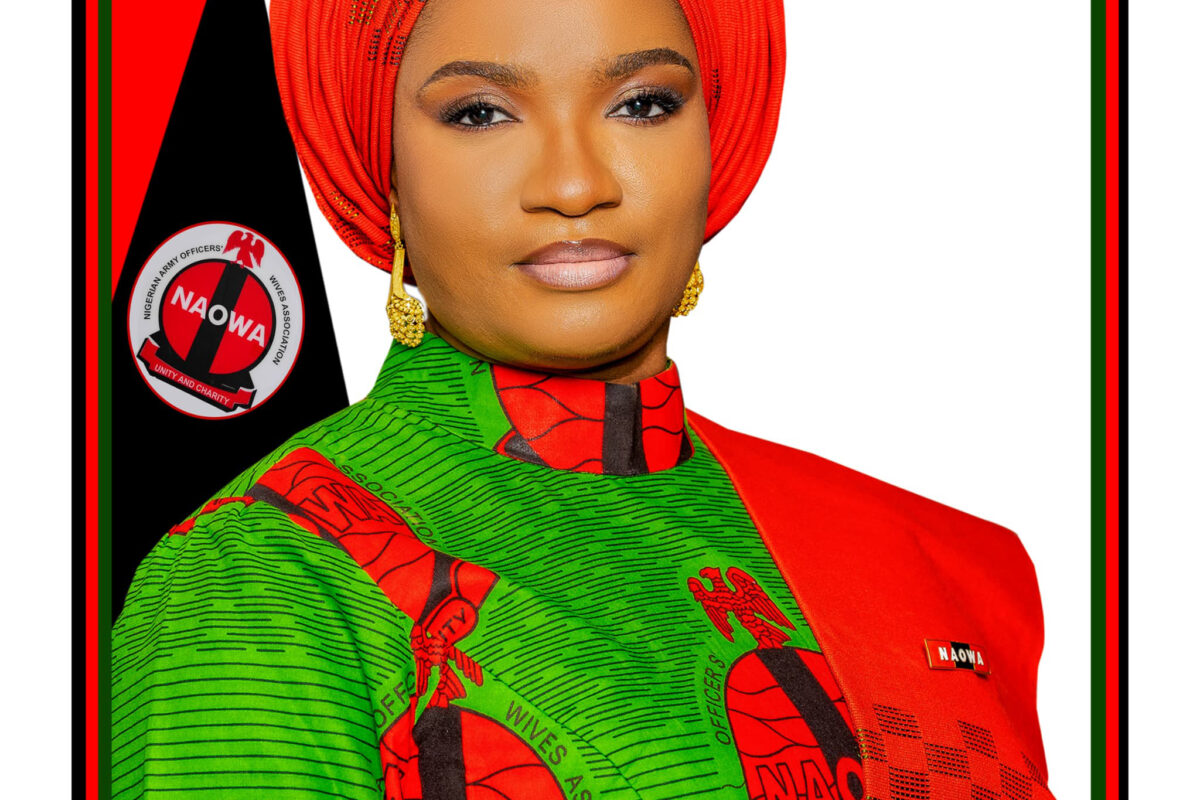
The Strategic Seal Dr Safiyyah Hassan Shaibu, President of the Nigerian Army Officers’ Wives Association and Wife of the Chief of Army Staff, Formally Accepts Nomination as Strategic Ambassador for the UNESCO REF Strategic Intervention Programmes for Accelerated Learning and Productive Human Asset (SIP-ALPHA).There is a particular kind of leadership that does not announce itself. It simply shows up in barracks, in garrison towns, in the quietest corners of a nation at war with poverty, insecurity, and underdevelopment and builds something that outlasts the headlines. Dr Safiyyah Hassan Shaibu has spent her public life doing exactly that. On 28 July 2026, she stepped into a larger theatre.
ABUJA, NIGERIA The Read and Earn Federation for UNESCO (UNESCO REF) announces that Dr Safiyyah Hassan Shaibu, the 25th President of the Nigerian Army Officers’ Wives Association (NAOWA) and wife of Lieutenant General Waidi Shaibu, Nigeria’s Chief of Army Staff appointed by President Bola Ahmed Tinubu, has formally accepted her nomination as Strategic Ambassador for the UNESCO REF Strategic Intervention Programmes for Accelerated Learning and Productive Human Asset (SIP-ALPHA) in Nigeria.
The acceptance, conveyed by official correspondence dated 28 July 2026 under NAOWA reference NAOWA/NAT/G1/300/63, is not a ceremonial gesture. It is a considered institutional decision made, as Dr Safiyyah Hassan Shaibu herself wrote, after having “carefully considered the objectives, scope and strategic vision of the SIP ALPHA Initiative.” It is the decision of a woman who leads by conviction, not by title.
The Woman Behind the Mandate
Dr Safiyyah Hassan Shaibu, President of the Nigerian Army Officers’ Wives Association, was honoured with the Leading Emerging Women Leader in Africa Award for her contributions to women’s development and community service a continental recognition that speaks not to her position, but to the substance of her work.
At her first Executive Meeting as the 25th President of NAOWA, she declared that the association was built on service and sacrifice, representing women who supported soldiers on the frontlines while raising families and sustaining communities at home. She entered that office not as a ceremonial figurehead but as a leader who understood, from the inside, what it means to hold a community together under pressure.
As recently as 15 July 2026 just weeks before signing her acceptance letter to UNESCO REF Dr Safiyyah Hassan Shaibu commissioned newly constructed educational and welfare facilities at Bola Ahmed Tinubu Barracks and Mogadishu Cantonment in Abuja, describing these projects as strategic investments in the welfare, education and well being of Nigerian Army families. This is a leader whose instinct, when given power, is to build.
She is fondly known within military circles as “Mama Continuity” a title that captures both her disposition and her doctrine: that meaningful development is not built in bursts of ambition but in the steady, disciplined accumulation of institutional effort across time.
The Institution She Leads
The Nigerian Army Officers’ Wives Association has been described as “the most powerful women’s organisation in the country.” That description is not hyperbole. Founded in the 1950s and formally constituted under its current name in 1963, NAOWA has, for over six decades, operated hospitals, schools, skills acquisition centres, crèches, cooperative societies, and humanitarian programmes across a network that follows the Nigerian Army’s presence into every state, every local government, every garrison town in the Federation.
It reaches where government policy often cannot. It holds communities together where institutional presence is thin. And it does so without subvention from federal or state government sustained entirely by the commitment of its members and the leadership of its successive presidents. Dr Safiyyah Hassan Shaibu is the 25th of those presidents. She inherited a legacy. She is expanding it.
The Man Beside Her And Why It Matters
Lieutenant General Waidi Shaibu was announced as the 25th Chief of Army Staff once wounded in action, the decorated commander and seasoned strategist brings a blend of operational experience, academic rigour, and unyielding commitment to Nigeria’s sovereignty.
Appointed by President Bola Ahmed Tinubu on 30 October 2025, Lieutenant General Waidi Shaibu’s operational record spans counter insurgency campaigns against Boko Haram and ISWAP, including deployments in the Lake Chad region and Sambisa Forest. He holds the Purple Heart Medal for gallantry.
Behind every theatre of war is a home front. Behind every general is a family sustained by sacrifice. Dr Safiyyah Hassan Shaibu has lived that reality and she has chosen to transform it into a mandate for national development. When the wife of Nigeria’s most senior Army officer formally commits to a UNESCO development framework, it is not a soft institutional gesture. It carries the moral weight of the institution her husband commands and the lived experience of every military family across this Federation.
A Convergence That Was Not Accidental
The road to this appointment began on 18 May 2026, when UNESCO REF President Prince Abdulsalami Ladigbolu – Oranmiyan held a high level consultative engagement with Dr Safiyyah Hassan Shaibu at NAOWA headquarters in Abuja. The conversation examined alternative institutional pathways for advancing the United Nations Sustainable Development Goals in Nigeria through the SIP-ALPHA Framework.
Two institutions sat across from each other. One had seventeen years of multi sectoral development architecture, a framework that had contribited to mobilizing 1.2 million Nigerian youth, and partnerships spanning Westminster to Washington. The other had six decades of grassroots presence, community trust built not through campaigns but through consistent service, and a network that reached into places no programme map could fully represent. They recognised, in each other, what neither possessed alone. What began as a strategic conversation became, on 28 July 2026, a formal institutional covenant.
In Her Own Words
“Having carefully considered the objectives, scope and strategic vision of the SIP-ALPHA Initiative, particularly its alignment with the United Nations Sustainable Development Goals and the African Union Agenda 2063, I further recognise its strong emphasis on sustainable development, food security, education, youth advancement, health resilience and community empowerment. It is therefore with great pleasure that I formally accept this nomination and appointment as Strategic Ambassador for SIP -ALPHA.
“I look forward to collaborating closely with UNESCO REF, development partners and other relevant stakeholders in achieving the objectives of SIP-ALPHA for the benefit of our nation and future generations.” Dr Safiyyah Hassan Shaibu 25th President, Nigerian Army Officers’ Wives Association (NAOWA) Abuja, 28 July 2026.
The UNESCO REF President Responds
“Dr Safiyyah Hassan Shaibu’s formal acceptance of this nomination is one of the most consequential institutional developments in UNESCO REF’s seventeen year history. NAOWA does not lend its name it lends its capacity, its networks, and its communities. As Strategic Ambassador for SIP-ALPHA, she brings to our framework the institutional discipline of an organisation forged in service, the grassroots reach of a network that no programme map can fully capture, and the moral authority of women’s leadership at its most credible.
Nigeria’s development cannot be delivered from Abuja alone. It must be assembled, community by community, in every barracks, every garrison town, every local government area of this Federation. That assembly now has a new and formidable architect.”
Prince Abdulsalami Ladigbolu – Oranmiyan. President & Secretary General, UNESCO REF.
What the Appointment Means for SIP-ALPHA
The Strategic Intervention Programmes for Accelerated Learning and Productive Human Asset (SIP ALPHA) is UNESCO REF’s most ambitious institutional architecture a governance innovation that moves from siloed programming to integrated, systems based development delivery across education, agriculture, health resilience, youth empowerment, and sustainable community development.
As Strategic Ambassador, Dr Safiyyah Hassan Shaibu brings NAOWA’s full national footprint into SIP ALPHA’s implementation architecture accelerating delivery across all 774 local government areas, in alignment with the Federal Government’s Renewed Hope Agenda, the African Union’s Agenda 2063, and the United Nations 2030 Agenda for Sustainable Development.
The SDG contributions are direct and measurable: Goals 1, 2, 4, 5, 8, and 17. But the deeper contribution is harder to quantify and more important. It is the trust of a nation’s military families, extended now into the architecture of its development future.
SDG 1 • SDG 2 • SDG 4 • SDG 5 • SDG 8 • SDG 17
SIP ALPHA Framework | Renewed Hope Agenda | AU Agenda 2063
Ref: UNESCO REF/MEDIA/2026/NAOWA SIP ALPHA AMB 01.
Issued by UNESCO REF Media Centre • info@unesco ref.org • Abuja, Federal Republic of Nigeria • August 2026.