
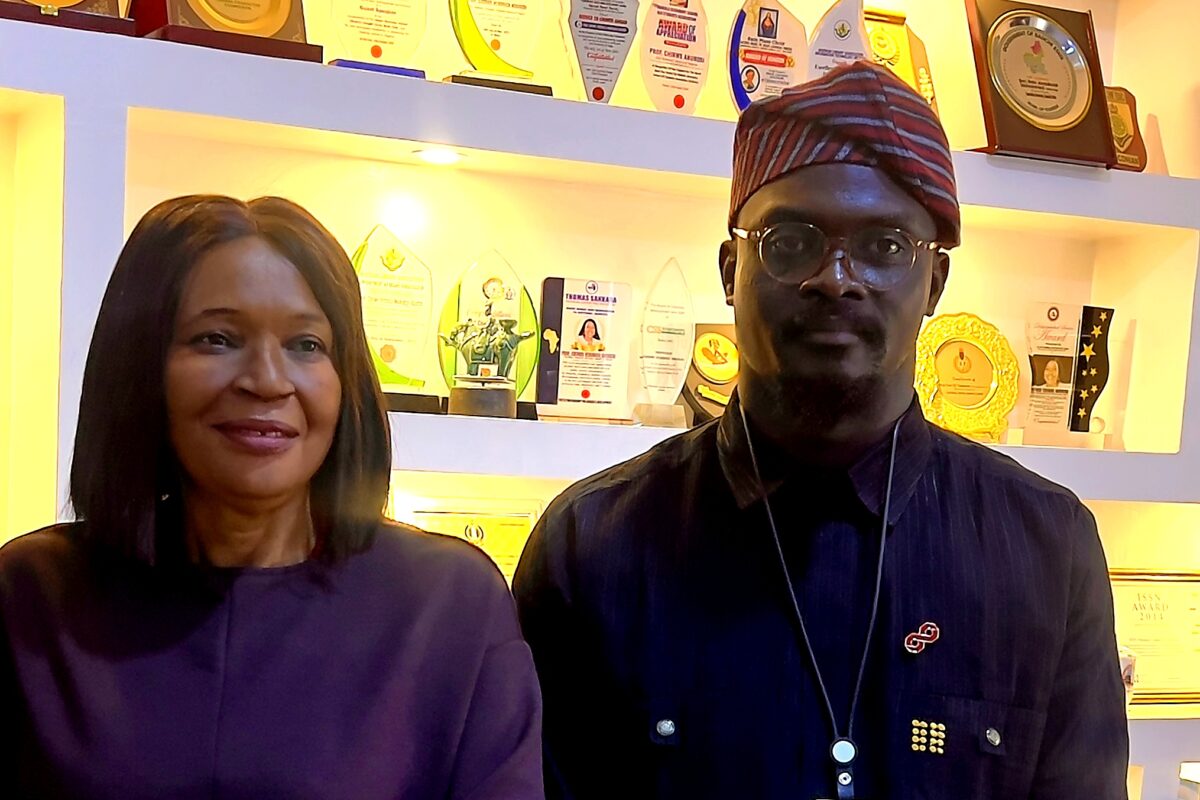
UNESCO REF President Concludes Strategic Working Visit to National Library of Nigeria
UNESCO REF Media Centre | News
UNESCO REF and the National Library of Nigeria finalise the framework for Anchored in Evidence: Digital Voices for a Stable Society, a fully sponsored programme training 600 young bloggers, content creators and online journalists to anchor public communication in verified fact.
ABUJA, Nigeria, 28 September 2026. The President of the Read and Earn Federation for UNESCO (UNESCO REF), Prince Abdulsalami Ladigbolu-Oranmiyan, today concluded a strategic working visit to the National Library of Nigeria in Abuja. The visit was hosted by the National Librarian and Chief Executive Officer of the National Library of Nigeria, Prof. Chinwe Veronica Anunobi.
Global alignmentAlignement mondialThe global commitments this story advances. Open to see how.
- SDG16
SDG 16, Peace, Justice and Strong Institutions (primary)
ProvisionTarget 16.10: public access to information and protection of fundamental freedoms
How Anchored in Evidence respondsConnects the public conversation to a national repository of verified information
- SDG4
SDG 4, Quality Education
ProvisionTarget 4.4: youth with relevant skills, including ICT skills; Target 4.7: knowledge for global citizenship
How Anchored in Evidence respondsFully sponsored professional training in evidence-based digital communication
- SDG8
SDG 8, Decent Work
ProvisionTarget 8.6: reduce the share of youth not in employment, education or training
How Anchored in Evidence respondsBuilds professional standards in the creator and digital media economy
- SDG17
SDG 17, Partnerships for the Goals
ProvisionTarget 17.17: effective public and civil society partnerships
How Anchored in Evidence respondsA partnership between a federal institution and UNESCO REF, at no cost to Government
- UNGP
United Nations Global Principles for Information Integrity, 2024
ProvisionTrust, resilience and public empowerment in the information ecosystem
How Anchored in Evidence respondsTrains the producers of public information to verify before they publish
- UNESCO
UNESCO Guidelines for the Governance of Digital Platforms, 2023
ProvisionMedia and information literacy as a pillar of a healthy information environment
How Anchored in Evidence respondsApplies media and information literacy to professional content creation
- UNESCO
IFLA-UNESCO Public Library Manifesto, 2022
ProvisionLibraries as gateways to knowledge and to reliable information
How Anchored in Evidence respondsPositions the National Library as the primary source for digital voices
- AU
African Union Digital Transformation Strategy for Africa, 2020 to 2030
ProvisionDigital skills and a trusted digital environment
How Anchored in Evidence respondsBuilds digital capacity among young Africans
- AA
Agenda 2063, Aspiration 6
ProvisionDevelopment driven by the potential of African people, especially youth
How Anchored in Evidence respondsEngages 600 young Nigerians across all six geopolitical zones
- NG
National Library of Nigeria Act
ProvisionMandate to collect, preserve and make available Nigeria’s recorded knowledge
How Anchored in Evidence respondsTurns that mandate into a daily reference point for the digital public
The working session finalised the modalities of a strategic partnership between the two institutions under Anchored in Evidence: Digital Voices for a Stable Society, a professional programme that places the nation’s foremost repository of knowledge at the centre of Nigeria’s digital conversation.
The programme
Le programme
Anchored in Evidence is a three-week, fully online professional training programme, fully sponsored by UNESCO REF under its Educational Financial Facility Scheme (EFFS). Its pilot cohort will comprise 600 young Nigerians drawn from all six geopolitical zones of the Federation.
The programme equips bloggers, digital content creators and online journalists with three core capacities:
- Evidence-based digital communication. The discipline of verifying claims before publishing them.
- Responsible national imaging. Communicating about Nigeria accurately, fairly and with a sense of public responsibility.
- The Library as primary source. The habit of consulting the National Library of Nigeria for empirical fact, rather than relying on unverified social media trends.
The working session
La séance de travail
Discussions between Prince Ladigbolu-Oranmiyan and Prof. Anunobi covered four areas:
- The partnership framework between UNESCO REF and the National Library of Nigeria.
- Modalities for the identification, mobilisation and enrolment of participants.
- The pilot region strategy for the initial cohort of 600 trainees.
- The media awareness plan to secure the visibility and credibility of the programme launch.
Prince Ladigbolu-Oranmiyan emphasised that the programme requires no financial commitment from the National Library of Nigeria, as it is fully funded by UNESCO REF. He noted that the collaboration will equip young Nigerians with critical digital skills while reinforcing the Library’s role as a trusted custodian of knowledge and fact in the digital age.
Prof. Anunobi welcomed the partnership, highlighting its alignment with the Library’s ongoing digital transformation agenda and with its mission to serve as Nigeria’s foremost repository of credible information.
The visit concluded with mutual agreement on the importance of institutional synergy in addressing misinformation and in promoting a culture of responsible communication.
Why it matters
Les enjeux
The programme responds to a challenge that is now recognised as global. The World Economic Forum’s Global Risks Report 2025 ranked misinformation and disinformation as the most severe global risk over the next two years, for the second consecutive year.
Those who shape the digital conversation are often the least equipped to verify it. A 2024 UNESCO survey of digital content creators, published as Behind the Screens, found that 62 per cent do not systematically verify information before sharing it. The same study found strong demand for training: more than 9,000 creators enrolled in the free course UNESCO launched in response.
Anchored in Evidence answers that demand in Nigeria, one of the youngest populations in the world, by pairing digital creators with an institution whose statutory mandate is to collect, preserve and make available the nation’s recorded knowledge.
Next steps
Prochaines étapes
With the modalities agreed, the two institutions will proceed to the identification, mobilisation and enrolment of the pilot cohort and to the media awareness campaign for the launch. The pilot cohort of 600 participants will serve as the model for future expansion, demonstrating the contribution of evidence-based digital voices to national stability.
ENDS
Notes to editorsNotes aux rédactions
About Anchored in Evidence. Anchored in Evidence: Digital Voices for a Stable Society is a three-week professional training programme for bloggers, digital content creators and online journalists, delivered online in partnership with the National Library of Nigeria and fully sponsored by UNESCO REF under its Educational Financial Facility Scheme (EFFS).
About the National Library of Nigeria. The National Library of Nigeria is the federal institution charged with collecting, preserving and making available the recorded knowledge of the nation.
About UNESCO REF. The Read and Earn Federation for UNESCO (UNESCO REF) works to strengthen human and institutional capacity across Nigeria and Africa through education, research and professional development, in alignment with the 2030 Agenda for Sustainable Development.
Media enquiries. UNESCO REF Media Centre, [email protected]
SourcesSources
- Leadership: President of UNESCO REF
- Office of the National Librarian, National Library of Nigeria
- Global Risks Report 2025, World Economic Forum
- Behind the Screens: the credibility challenge of digital content creators, United Nations University
- UNESCO survey: two thirds of digital content creators skip fact-checking, IT Edge News
- UNESCO: 9,000 content creators sign up for training on how to avoid spreading misinformation, Kolsquare